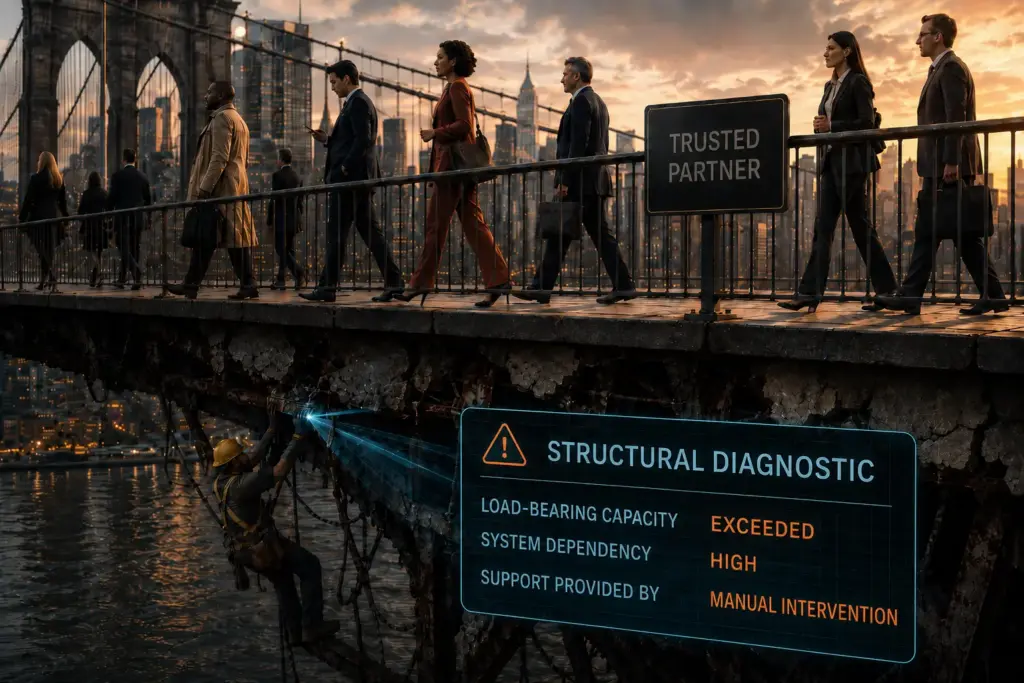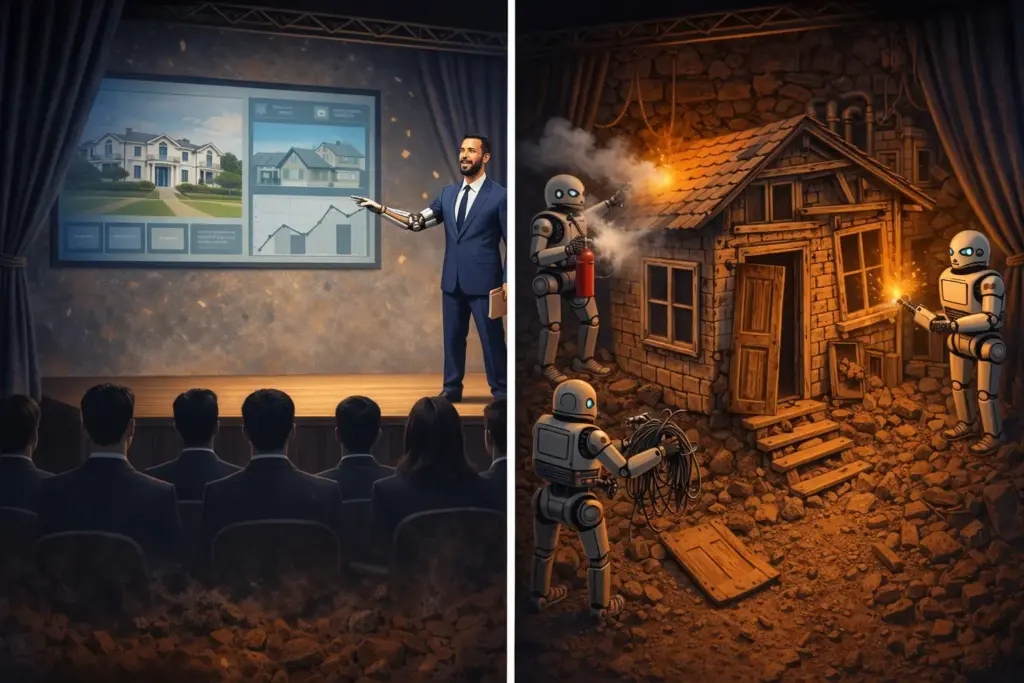
Clients aren’t buying confidence.
They’re buying the work you did before you met them.
Let’s balance the ledger. In Being a Good Client, I acknowledged that bad vendors exist: firms that layer profit into every handoff, overpromise, underdeliver, and scale by throwing bodies at service. Organizations that sell confidence instead of outcomes.
That wasn’t the focus of that article. This one is.
I’ve spent most of my career inside companies that deliver services to other companies, including consultancies, MSPs, MSSPs, enterprise security firms, and now my own business. I’ve seen organizations that treat delivery as a discipline and others that treat it as something that somehow happens after the deal closes.
From the outside, both can look equally credible. The branding is polished, the sales team articulate, the case studies impressive, and leadership confident. Clients naturally assume the work behind the scenes matches the presentation.
Sometimes it does. Often, it doesn’t.
Clients do not go to market for a performance. They go because something matters enough to trust someone else with it: a migration that cannot fail, a compliance deadline that cannot slip, a security problem they cannot solve internally, or growth their current systems cannot sustain.
They are not simply buying tools or labor. They are buying competence under pressure.
Good vendors prepare for that pressure long before they encounter it. Weak vendors prepare for the pitch.
When discovery starts after the contract is signed, alignment is deferred to onboarding, and risk management begins in production, the system starts compensating. Onboarding becomes archaeology. Engineers reverse-engineer scope in real time. Delivery teams inherit promises they did not make, and clients become stress tests for the vendor’s internal coordination.
What looked like confidence during sales becomes improvisation during execution.
From the client’s perspective, this feels less like a partnership and more like a handoff into controlled chaos. Most of the time, the cause is not fraud or bad intent. It is structural unreadiness.
Sales has outpaced delivery. Growth has outpaced process, hiring, and training. Commitments are made without confirming that the organization can absorb them. The machinery required to deliver what was promised either does not exist or cannot operate reliably at the current scale.
After enough engagements, this stops looking like a collection of isolated failures.
It starts looking like a system.
Not anecdotes. Physics.
What Clients Are Actually Buying
Clients are not buying access to tools or documentation. They can obtain those themselves. They are not even buying expertise in isolation, because knowledge alone does not guarantee a good decision.
They are buying applied judgment.
That judgment comes from seeing similar problems across different environments, constraints, and failure modes. It is the ability to predict consequences before they appear, identify risks hidden inside apparently simple decisions, and surface tradeoffs before they become expensive or political.
Anyone can learn how to install software. Not everyone can predict what that software will do to an organization.
In technology services, this distinction is often blurred by a supply chain of roles that look similar from the outside. Resellers move products. Value-added resellers bundle them into solutions. Consultants design implementations. Managed service providers operate systems over time.
Each layer implies greater responsibility for outcomes, but the title does not guarantee that the organization is prepared to accept it.
A company may advertise strategic partnership while operating like a transactional reseller. It may sell consulting while relying on vendor documentation and trial and error in production. From the client’s side, the difference may remain invisible until something goes wrong.
The value of an experienced vendor is not merely that they know how a product works. It is that they know how it fails.
They know which integration points become bottlenecks, which features create operational drag, which roadmap promises can be trusted, and which edge cases appear only at scale. They know which problems resolve cleanly and which ones remain embedded in an environment for years.
That knowledge is rarely captured in documentation. It accumulates through troubleshooting, escalation calls, outages, emergency reversals, vendor negotiations, and environments that could not afford failure.
Documentation tells you how something is supposed to behave. Experience tells you how it behaves in the wild.
Judgment becomes especially valuable when there is no single correct answer. Most technology decisions involve several viable options, each carrying a different mixture of cost, risk, complexity, and disruption.
The real work is not selecting the objectively best tool. It is deciding which compromises the organization can live with.
A mature vendor does not hide those compromises behind confidence. They make them visible, explain the consequences, identify where the burden will fall, and help the client choose consciously rather than discovering the cost later.
Technology decisions also affect more than systems. They reshape workflows, incentives, responsibilities, and habits that may have developed over many years. A technically correct solution that ignores those realities can damage productivity, morale, and trust before it produces any measurable benefit.
Ultimately, clients are paying a vendor to navigate uncertainty on their behalf. They are paying someone to identify risks they cannot yet see, anticipate consequences they have not experienced, translate technical decisions into business outcomes, and help them avoid mistakes they may only get one opportunity to make.
They are buying the accumulated experience of having done this before, repeatedly and under pressure.
That is the work you did before you met them.

“Experience is a hard teacher because she gives the test first, the lesson afterward.” - Vernon Law
The Reseller Mindset vs The Stewardship Mindset
Not every vendor approaches client work the same way. Some treat an engagement primarily as a transaction. Others treat it as a responsibility.
From the outside, both may look professional. The difference is what each believes happens after the deal closes.
The reseller mindset is transactional. Success is defined by placing a product, closing a contract, or moving revenue across the finish line. Once the transaction is complete, responsibility shifts back to the client or forward to another team.
That model is not inherently unethical. Many clients need straightforward procurement, and many vendors are built to provide exactly that. The problem begins when a transactional service is presented as ownership of an outcome.
The problem is not the transaction. It is pretending the transaction is stewardship.
The client believes it is purchasing guidance, continuity, and accountability. The vendor delivers procurement, implementation assistance, and periodic check-ins. While conditions remain stable, the difference may be difficult to see. Under pressure, it becomes unmistakable.
Stewardship operates differently. A steward assumes that introducing technology creates consequences that continue long after implementation. They consider the support burden, integration friction, user adoption, maintenance requirements, operational cost, and the organization’s ability to live with the decision over time.
Revenue is not the finish line. It is the beginning of responsibility.
This mindset produces harder conversations earlier. A steward may expand discovery, question an assumption, recommend a slower rollout, or decline to sell something the organization is not ready to support. They may introduce friction into the sales process because removing friction from the sale often shifts it into delivery.
From a transactional perspective, that caution can look obstructive. From an outcomes perspective, it is risk management.
The central distinction is ownership. A reseller can complete the transaction even if the client later struggles with the result. A steward cannot consider the work successful if the solution creates instability, unsustainable cost, or long-term dependence the client did not understand.
That changes behavior. Timelines become more realistic, promises more conservative, and durability more important than novelty. Recommendations are judged by what happens after deployment, not by how persuasive they sounded before it.
Many organizations move between these mindsets without acknowledging it. They may begin with a strong culture of stewardship, then drift toward transaction as growth pressure increases. Sales makes more commitments, delivery absorbs them, and account management works to preserve the relationship.
No one announces that stewardship is being abandoned. It erodes through incentives, capacity constraints, and small compromises that seem reasonable in isolation.
Clients rarely see the internal cause. They experience thoughtful guidance in one engagement, transactional behavior in the next, and a growing uncertainty about what kind of partner they actually hired.
“We are responsible for what we do, but also for what we do not do.” - Molière
Tradeoffs Are the Real Product
Once judgment becomes the product, tradeoffs become the work.
Every meaningful technology decision exchanges one form of risk for another. Security competes with usability. Standardization limits flexibility. Speed can reduce stability. Cost savings may weaken resilience, while innovation introduces operational uncertainty.
Technology does not eliminate pain. It redistributes it.
Every tool, architecture, policy, or process solves one problem while creating another. Security controls add friction. Automation improves consistency but may reduce local discretion. Standardization makes systems easier to support while limiting autonomy. Cost reductions often move risk into the future, where it becomes less visible and more expensive.
Amateurs search for perfect solutions. Experienced vendors map consequences.
The useful question is not, “Which option is best?” It is, “Which combination of benefits, limitations, and risks can this organization absorb without destabilizing itself?”
The answer depends on context. Staffing levels, skill distribution, regulatory pressure, growth plans, risk tolerance, budget cycles, and cultural resistance all shape whether a particular solution will succeed. A tool that stabilizes one environment may overwhelm another.
Product documentation rarely captures this reality. It describes features and supported configurations, not the accumulated effects of using the product inside an imperfect business. It does not show how a feature will interact with a legacy process, how an update will affect a critical workflow, or how several minor limitations will compound over time.
Those lessons come from environments where decisions had consequences: failed rollouts, emergency reversals, performance bottlenecks that appeared only at scale, and security controls that users routed around because ordinary work had become too difficult.
Experience accumulates those patterns, not as abstract theory, but as memory.
Tradeoffs also operate across time. Some choices create immediate disruption but long-term stability. Others feel painless during implementation and produce years of maintenance burden. Deferred complexity has a habit of returning with interest.
Clients may encounter that cost long after the vendor who recommended the solution has moved on. A mature vendor explains not only the immediate impact of a decision, but also what it is likely to demand six months, two years, or five years later.
This is not an argument against progress. It is an argument for informed commitment.
Because tradeoffs are unavoidable, pretending otherwise is itself a decision. Overselling certainty weakens trust when reality diverges from the promise. Underexplaining consequences leaves clients unprepared for the operational cost of success.
Good vendors make the exchange explicit. They translate technical implications into business language, identify who will bear the burden of each choice, and help the client decide whether that burden is acceptable.
The vendor is not simply selling an answer. It is improving the quality of the decision.
That is foresight: seeing around corners the client has not yet approached, recognizing patterns that repeat across organizations, and warning when a seemingly minor choice will constrain future options.
Foresight is the difference between deploying technology and guiding change.
“You can have anything you want, but not everything you want.” - Peter Drucker
Representing Change to a Living System
Organizations are not simply technical environments. They are living systems made of people, habits, incentives, informal workflows, and accumulated compromises. Technology sits inside that structure, not apart from it.
New tools and policies do not arrive on a clean slate. They enter routines that may have developed over years, often in response to constraints no one remembers clearly enough to document. What looks inefficient from the outside may be the only way the organization has found to keep operating.
A vendor represents change entering that system. The client represents continuity.
Successful implementation depends on more than whether the solution is technically correct. It also depends on whether the organization can absorb the change without losing its ability to function.
This is why solutions that look right on paper often fail in practice. They collide with undocumented dependencies, informal authority structures, competing initiatives, and simple human exhaustion. The implementation may work exactly as designed while the organization quietly rejects it.
Every organization has a threshold for change. Cross it, and resistance appears.
That resistance is not always explicit. It may show up as delayed adoption, partial implementation, new workarounds, quiet returns to old processes, or support tickets that sound technical but are really expressions of frustration.
Employees are rarely trying to sabotage progress. They are trying to keep doing their jobs under changing constraints. When a new system makes ordinary work harder, people adapt around it.
End users are not obstacles to implementation. They are the operating environment in which the implementation must survive.
A technically elegant rollout that degrades daily work can fail before any dashboard detects the problem. Over time, the gap between the promised improvement and the lived experience erodes trust in both the technology and the people who introduced it.
Change also redistributes power. Automation alters roles. Monitoring increases visibility. Centralization reduces local control. Security policies constrain behavior that was previously flexible.
These changes may be justified, but they are never neutral.
People evaluate a system according to more than whether it functions. They ask whether it makes their work easier or harder, whether it increases or reduces their autonomy, and whether it makes their position more secure or more precarious.
Ignoring those questions does not eliminate them. It ensures they emerge later, when they are harder to address.
A mature vendor anticipates this response. Communication, training, rollout pacing, and support capacity are planned alongside the technical implementation. The vendor identifies which groups will experience the greatest disruption, watches for signs of overload, and helps leadership understand where friction will appear and how long it may last.
The goal is not to eliminate disruption. Meaningful change usually creates some. The goal is to keep it below the level where it compromises operations, exhausts the workforce, or destroys confidence in the initiative.
Successful change feels less like a shock and more like controlled evolution. Work continues. Productivity dips are temporary and understood. Support is available when friction appears. Improvements become visible before patience runs out.
That outcome requires preparation before deployment begins. It requires understanding the organization as it actually operates, not merely as it is described in policies, diagrams, and project plans.
A vendor is not only implementing technology. It is intervening in a living system.
Whether that intervention strengthens or destabilizes the organization depends on how well the vendor understands what already exists and how carefully it introduces what comes next.
“The art of progress is to preserve order amid change and to preserve change amid order.” - Alfred North Whitehead
Client Intel vs Vendor Theater
Many vendor engagements produce a steady stream of visible activity: status reports, dashboards, quarterly reviews, roadmaps, ticket metrics, adoption charts, compliance checklists, and slide decks.
From a distance, this can look like alignment. Sometimes it is. Sometimes it is theater.
Activity is not the same as understanding.
Client intelligence is not primarily a record of what the vendor has done. It is an understanding of how the client operates and what determines whether the business succeeds or struggles.
That includes revenue drivers, cost pressures, growth plans, regulatory constraints, customer expectations, competitive threats, internal politics, risk tolerance, and decision-making style. Without that context, technically excellent work can remain strategically irrelevant. Systems may improve while the business problem that justified the investment remains unchanged.
Vendors that lack this understanding tend to default to what they can measure easily: ticket volume, response times, patch compliance, uptime, utilization, feature adoption, and security events blocked.
Those metrics matter. They describe parts of operational health, but they do not automatically demonstrate business impact. They answer “Are we doing work?” more readily than “Is this work making the organization stronger?”
Reporting becomes theater when proving activity replaces understanding outcomes.
Quarterly reviews can intensify the problem. A prepared presentation replaces a real conversation. Standardized templates replace curiosity. The vendor explains what happened during the previous quarter while leaving little room for uncomfortable questions about what is changing next.
A strategic conversation asks something different. What is changing in the client’s industry? Which internal initiatives are failing? Where is the organization losing time, money, or trust? What risks occupy leadership’s attention? Which constraint, if removed, would materially improve the company’s ability to compete?
The answers determine whether a technology recommendation matters.
Client intelligence also includes things that rarely appear in formal documentation: budget timing, leadership turnover, organizational fatigue, hidden dependencies, political sensitivities, and informal centers of authority. Ignoring those forces does not remove them. It ensures that plans will eventually collide with them.
Vendor theater prioritizes visibility over insight. It focuses on demonstrating value rather than understanding where value is actually created.
Theater scales easily. Understanding does not.
Templates can be reused. Metrics can be standardized. Presentations can be delivered with minimal customization. Understanding a particular organization requires listening, continuity, context, and sustained attention.
A true partner invests in that understanding throughout the relationship. They connect technical recommendations to business outcomes, adjust priorities as the client evolves, and surface risks beyond the immediate scope of work. Their goal is not merely to prove their worth. It is to increase the client’s ability to succeed.
Clients rarely state that expectation directly. They assume a strategic partner will seek the knowledge required to advise them well. When that does not happen, disappointment develops slowly.
The vendor remains responsive but not proactive, competent but not insightful, present but not engaged. The contract continues, but the sense of partnership fades.
Dashboards describe the visible surface of the relationship. Client intelligence describes the terrain beneath it.
One shows what has been done. The other determines what should happen next.
“Information is not knowledge.” - Albert Einstein
Walking the Organization: Sales -> AM -> Delivery
Large vendor organizations do not operate as a single mind. They operate through a sequence of functions, each with different incentives, information, and definitions of success. The client experiences one company, but internally, sales, account management, and delivery may experience the same engagement as three different realities.
What looks like inconsistency from the outside is often fragmentation on the inside.
Sales meets the client first. Its job is to understand the need, position a solution, and win the opportunity. That work happens under time and competitive pressure, so discovery will always be incomplete. Perfect discovery would often require doing much of the work before being hired to do it.
Optimism is not inherently a flaw. It is part of the function. It becomes dangerous when commitments are made without confirming that the delivery system can support them. Nuance gets compressed into a persuasive narrative, edge cases are deferred, and unknowns are described as manageable. The deal closes, and responsibility moves forward.
Account management inherits the relationship. Its job is to maintain trust, coordinate communication, and help the client feel supported over time. Account managers translate between business expectations and operational reality, often without direct authority to change either. When promises exceed delivery capacity, they become buffers, absorbing frustration and renegotiating expectations while problems are addressed behind the scenes.
Because success in this role is often measured through retention, a stable relationship can coexist with unresolved operational problems. The client remains, but the outcome that originally justified the relationship may continue drifting further away.
Delivery eventually encounters the environment as it actually exists. Engineers, consultants, and operators inherit the client’s systems along with assumptions formed before full visibility was possible. They become accountable for outcomes despite having had little influence over the commitments that defined them.
Legacy systems behave unpredictably. Documentation is incomplete. Dependencies emerge that were never discussed. Timelines collide with maintenance windows, business cycles, internal politics, and operational constraints. Delivery teams are not discovering these problems for the first time. They are discovering them first.
Each function sees the resulting gap differently. Sales sees an agreement based on the best information available at the time. Account management sees a relationship that must be protected. Delivery sees commitments that may no longer align with reality. None of those perspectives is necessarily dishonest or incompetent. The problem is that without strong feedback loops, they never converge.
In a healthy organization, information moves backward as well as forward. Delivery alerts account management to emerging risks. Account management adjusts expectations with the client. Sales learns which assumptions proved inaccurate and changes future discovery and positioning. Leadership updates pricing, staffing, process, and service design to reflect what the organization has learned.
That is organizational learning. Without it, the same problem repeats with a different client.
Growth pressure weakens these loops. Sales targets rise, new employees arrive without historical context, delivery capacity stretches, and account managers carry more relationships. Urgent work displaces the reflective work required to improve the system. The organization continues operating, but coherence erodes.
Clients experience that erosion through conflicting answers, changing timelines, repeated requests for the same information, and recommendations that depend on who is in the room. They begin to suspect that no one holds the complete picture. It is easy to interpret this as indifference, but more often, it is responsibility distributed across a system that was never designed to coordinate at its current scale.
Each person may be working diligently while the system produces an outcome no one intended.
Clients do not experience your organizational chart. They experience your organization. They do not care whether a breakdown began with incomplete discovery, an overloaded account manager, or insufficient delivery capacity. The result is the same: reduced trust.
Trust depends on coherence. When each part of the vendor demonstrates a shared understanding of the problem and a consistent approach to solving it, confidence grows. When messages diverge, even small discrepancies accumulate into doubt.
Mature vendors treat alignment across sales, account management, and delivery as a core capability rather than an administrative exercise. They invest in structured handoffs, shared context, realistic scoping, and feedback loops that allow delivery reality to reshape future sales conversations.
Sustainable growth depends on closing the loop between promise and execution. Without that loop, every new engagement begins slightly more fragile than the last.
“The whole is greater than the sum of its parts.” - Aristotle
Why Scaling Without Maturity Breaks Clients
Growth magnifies whatever already exists. When processes are strong, scale creates leverage. When they are fragile, scale multiplies instability.
From the outside, the vendor may look increasingly successful. Inside, the organization becomes harder to operate, and clients begin experiencing the consequences.
Early in a company’s life, structural gaps can be hidden by proximity. Founders remain accessible, senior employees handle critical work personally, and institutional knowledge is concentrated in a small group. Problems are solved through familiarity, effort, and informal coordination.
That model can produce excellent results. It cannot scale indefinitely.
As headcount grows, communication paths lengthen, decisions become distributed, and context fragments. New employees inherit responsibility without inheriting the history behind it. Work that once moved through informal relationships now requires explicit systems, and when those systems are not built deliberately, improvisation fills the gap.
Hiring is often the first visible point of strain. Demand grows faster than the company can recruit, train, and integrate experienced people. New employees are placed into client work before they understand how the organization actually operates, so they rely on documentation that trails reality or colleagues who are already overloaded.
Clients experience the result as inconsistent answers, repeated requests for information, and solutions that vary depending on who performs the work. Inside the vendor, everyone is simply trying to keep up.
Institutional memory also degrades as the company grows. People leave, teams reorganize, tools change, and decisions lose the context that once made them understandable. Unless hard-won knowledge is preserved deliberately, it disappears faster than it can be replaced.
The organization begins relearning the same lessons with different clients.
Heroics create another early success pattern that eventually becomes a liability. A small group of highly capable people absorbs complexity and keeps difficult work moving. Their effort produces strong outcomes, but it also conceals the absence of repeatable systems.
When demand exceeds what those people can personally carry, performance drops quickly. Hero culture is not scalable infrastructure. It is deferred process design, and deferred process design always collects interest.
As complexity increases, coordination often becomes a greater constraint than technical ability. More clients, systems, dependencies, and parallel initiatives compete for the same limited expertise. Small delays begin to cascade, and without disciplined prioritization and capacity management, the company enters a permanent state of catch-up.
Clients feel that through slower responses, missed timelines, changing personnel, and increasingly reactive service.
Growth pressure makes correction difficult. Slowing intake looks like lost revenue. Investing in process reduces short-term capacity. Moving senior people away from client work weakens immediate coverage, while training new employees properly takes time the organization does not believe it has.
So the company keeps moving forward, even as the strain becomes visible.
Eventually, velocity begins masking fragility. The organization has to keep selling and delivering at speed because slowing down would expose how many outcomes depend on constant intervention.
Clients do not see that internal calculation. They see staff turnover, shifting points of contact, inconsistent recommendations, and initiatives that repeatedly stall or restart. Confidence erodes not because of one catastrophic failure, but because the vendor becomes unpredictable.
Scaling without maturity does more than create internal risk. It transfers that risk to clients. Projects become experiments in process development, onboarding becomes a stress test of coordination, and critical work proceeds under conditions the vendor would not have accepted at a smaller scale.
The client did not agree to become part of the vendor’s maturation process. They experience it anyway.
Mature organizations recognize this danger and constrain growth when necessary. They invest in training, documentation, service design, capacity planning, and feedback loops before expanding further. They treat operational coherence as a prerequisite for scale rather than assuming it will emerge as a byproduct.
That discipline is rarely visible from the outside.
Its absence always is.
“What got you here won’t get you there.” - Marshall Goldsmith
What Good Vendors Actually Do
Good vendors do not build a business around heroics. They build systems that make heroics unnecessary.
Preparation begins before revenue. Discovery precedes commitment, internal alignment happens before external promises, and capacity is treated as a real constraint rather than a temporary inconvenience that can always be solved through overtime.
Most of this work remains invisible to the client. Its absence does not.
Good vendors constrain what they sell. Their offerings reflect what the organization can deliver consistently, not everything the market may be willing to buy. New services are introduced only after the required processes, training, ownership, and escalation paths are in place. Saying “not yet” protects both the client and the vendor because growth follows capability rather than attempting to manufacture capability after the sale.
Good vendors invest in discovery. That includes technical discovery, but it extends beyond systems and configurations. They learn how decisions are made, who owns risk, what success means to leadership, where the business is fragile, and which previous initiatives have already exhausted the organization’s patience. That context shapes the recommendation as much as the technical environment does. Without it, even competent work can solve the wrong problem.
Good vendors surface tradeoffs early. Risks, constraints, dependencies, and second-order effects are discussed before work begins rather than explained after something goes wrong. Timelines reflect reality instead of optimism, and unknowns are acknowledged rather than disguised as confidence. This may slow the sales process, but it speeds up everything that follows.
Good vendors protect delivery capacity. Senior expertise is applied where it has disproportionate value. Workloads are managed to prevent chronic overload, and frontline employees have support and escalation paths so they are not forced to improvise beyond their experience. Consistency becomes a strategic asset, and clients experience that consistency as stability.
Good vendors preserve what they learn. Delivery realities inform account management, and account management informs sales. Repeated problems lead to process changes rather than individual blame, while lessons are documented before the context disappears. Experience becomes institutional instead of remaining trapped inside a few people.
Good vendors align incentives. Success is not measured solely by revenue, contract volume, or utilization. Client outcomes, retention quality, staff sustainability, and operational coherence carry real weight. A short-term win that creates long-term instability is treated as a loss.
Good vendors stay close to the client’s business, not only its technology. Conversations extend into strategy, risk, competition, and organizational change. Recommendations evolve as the client evolves. The goal is not to keep the client dependent, but to make the client more capable.
Good vendors accept responsibility for consequences. Introducing change means owning its effects after implementation, including the parts that were difficult to anticipate. Support does not disappear when a project milestone is reached. Adjustment is part of the work, and trust grows when the vendor remains accountable after the difficult parts begin.
Being a good vendor is not about sounding confident. It is about being prepared to discover uncomfortable realities, challenge assumptions before they become commitments, deliver consistently rather than merely convincingly, and say no when saying yes would cause avoidable harm.
Clients are not buying reassurance.
They are buying reliability under pressure.
Preparation is the real product.
“A bad system will beat a good person every time." - W. Edwards Deming