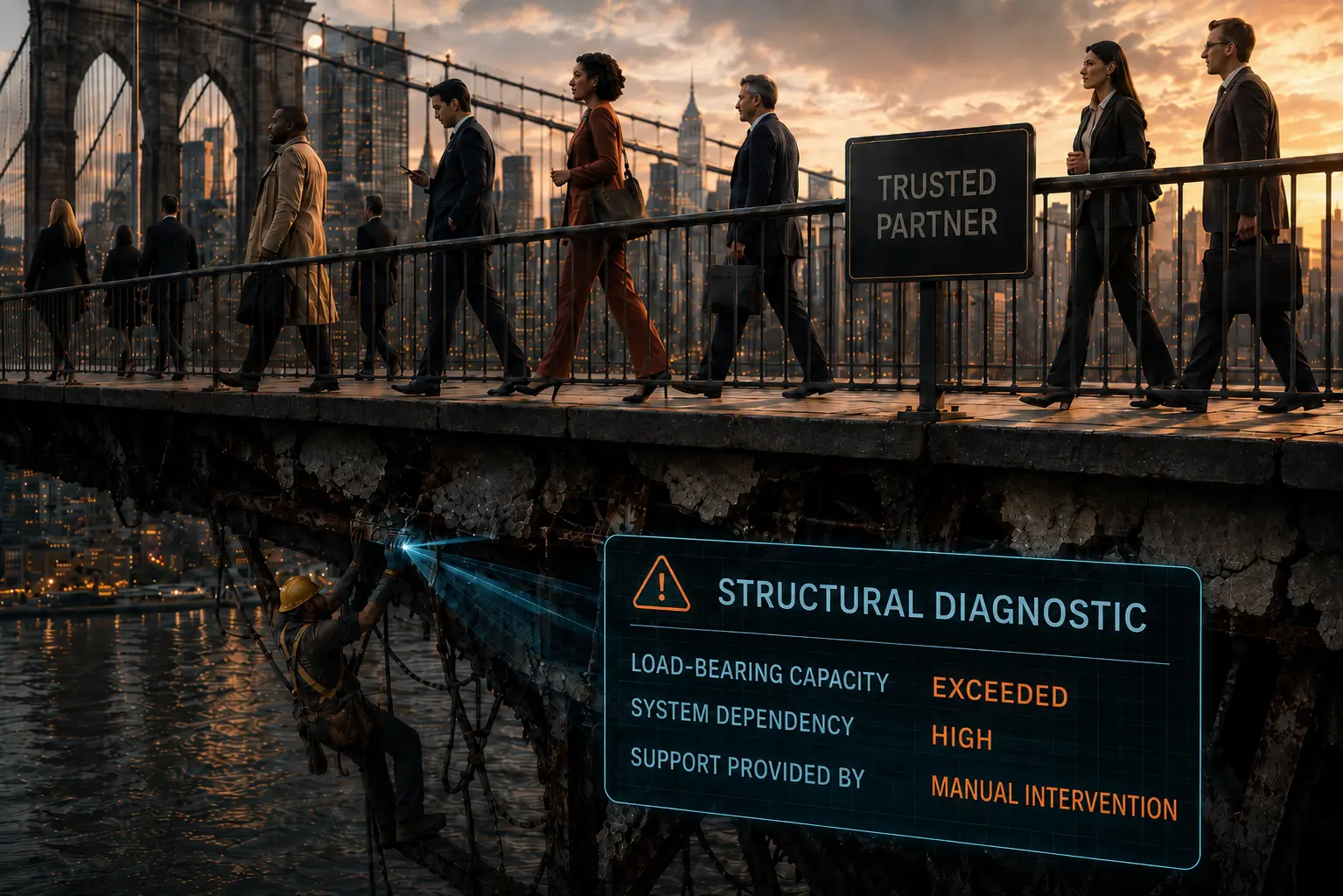
How companies sell more responsibility than their systems can carry
You have seen this company before. You may have worked for it, hired it, or trusted it with something important.
From the outside, it looks healthy. It makes payroll, grows revenue, retains customers, and passes formal reviews, all while carrying more responsibility than its people, processes, systems, and controls can reliably support.
It is financially healthy and operationally insolvent.
The gap is financed with trust.
I have spent much of my career at the boundary between what organizations promise and what their systems can actually carry, and I have seen that boundary from nearly every side: inside providers, on the buying side, and through consulting, contracting, partnerships, transitions, and running my own company. The operating models ranged from two-person shops to some of the world’s largest enterprises.
The scale changed. The mechanism did not.
Whenever a business outsources a critical function, it places part of its own operating system inside another organization. The contract buys more than labor, software, or expertise. It buys the expectation that the provider can preserve context, coordinate people, manage risk, recover from failure, and remain accountable after the reassuring people have left the room.
Too often, the promise exists before the machinery that would keep it.
So the system compensates. A capable employee catches the miss. A trusted advisor softens the explanation. A senior engineer reconstructs the context that was never written down. Someone stays late, absorbs the stress, and spends personal credibility to keep the promise intact for one more cycle.
Leadership sees a retained customer. The customer sees a familiar person who still seems to care. The frontline sees a system that would fail if people stopped rescuing it.
That hidden effort is what lets a company sell outcomes it cannot reliably produce through ordinary operation. The provider looks stable because the extraordinary work is consumed out of view. Recovery is mistaken for capability. Customer patience is mistaken for satisfaction. Renewal is mistaken for proof.
The company does not close the gap. It learns to live inside it.
This is trust debt: confidence, revenue, and responsibility accumulated faster than the capability required to justify them.
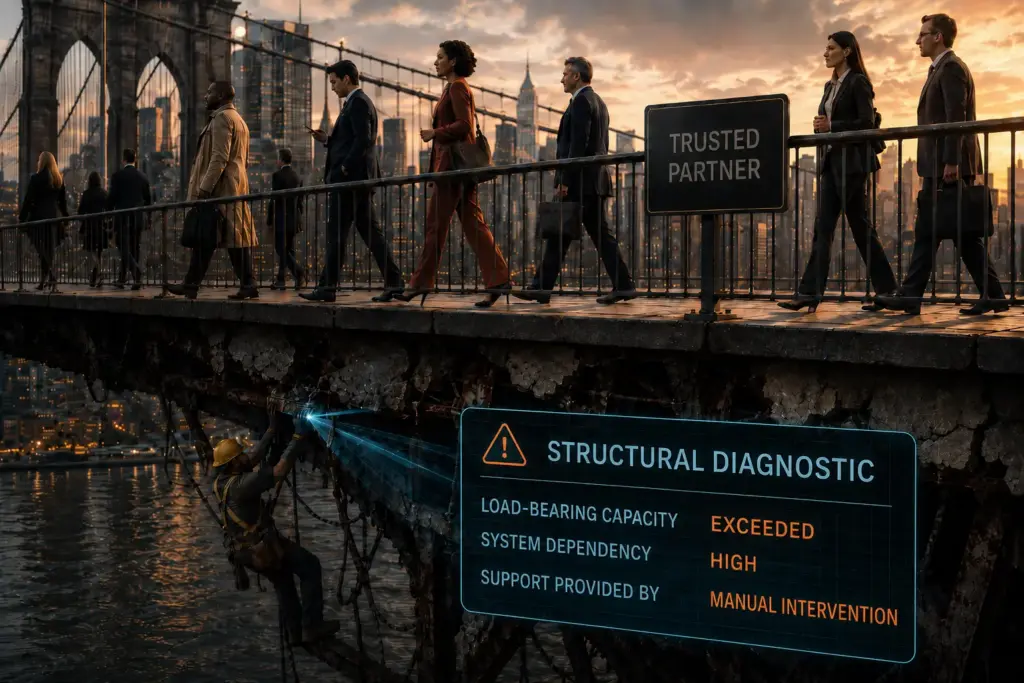
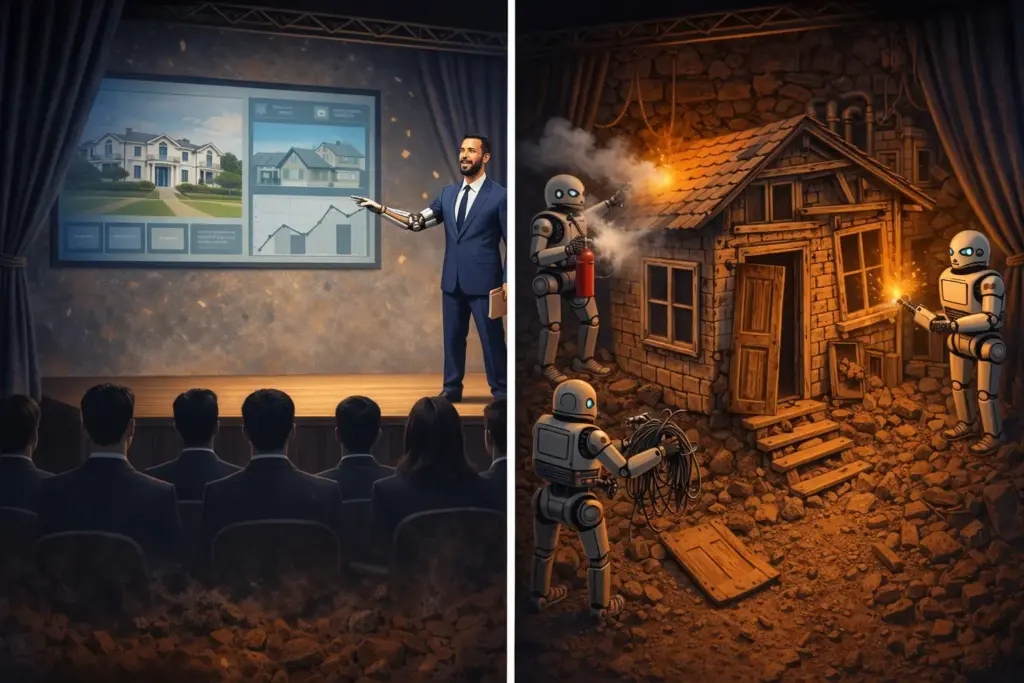
It can grow for years because customers rarely see the company behind the contract. They see the brand, the certification, the presentation, and the people assigned to maintain the relationship. They do not see the missing owner, the overloaded specialist, the undocumented dependency, or the control that exists in policy but not in practice.
Not every operationally insolvent company is running a deliberate scam. Some leaders know exactly how much of the story is theater. Others have told it so often that they can no longer separate the operating model from the people compensating for its absence. The customer carries the same risk either way.
They thought they outsourced the responsibility. Often, they only outsourced visibility into it.
For a long time, buyers had few ways to tell the difference. Financial due diligence, references, and certifications each answered a narrower question than they appeared to: whether a company was likely to stay in business, whether someone had a good experience, whether a defined set of controls held up within a stated scope and period.
None of them answered the more practical one: Can this organization reliably do what it is paid to do without burning a few heroic people or hiding the misses until they become the customer’s problem?
That question is getting easier to ask and harder to evade. Verification is becoming continuous, comparative, and available to more people, and customers will increasingly be able to set promises against records, policy against behavior, staffing against obligations, and reported outcomes against evidence.
The provider will no longer control the only interpretation of its own performance.
That should not frighten a good company. A strong organization can show how work is owned, how risk surfaces, how knowledge survives turnover, and how failure changes the system.
It will still make mistakes. Operational solvency is not perfection. It is the ability to carry your promises without depending on deception, customer confusion, or extraordinary sacrifice.
Trust is not the thing at risk. What is at risk is trust that no one can check.
The Company Behind the Contract
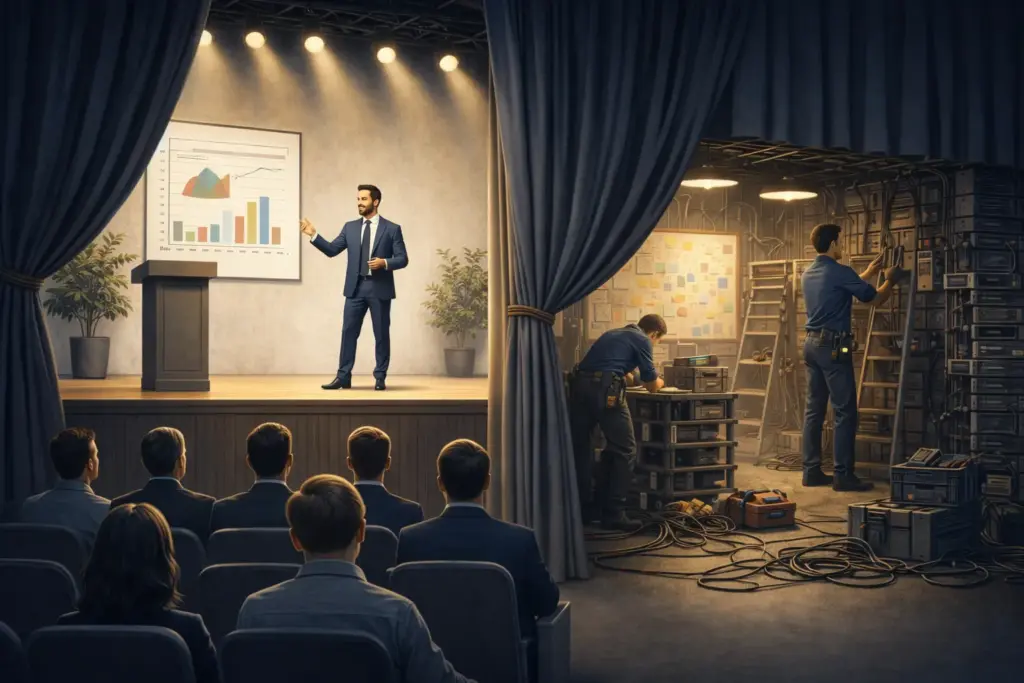
A customer raises a concern, and the right person joins the call. Calm, articulate, reassuring. They acknowledge the business impact and leave the customer confident the problem has been understood and is moving toward resolution.
Behind the scenes, ownership is far less settled. The relevant history is scattered across tickets, messages, documents, and the memories of people who were never on the call. Several teams are involved and none clearly owns the outcome. The person who reassured the customer may have influence but not direct authority over the people required to keep the promise.
The organization begins reconstructing certainty after it has already sold it.
Someone hunts for the missing context. A senior employee is pulled in because they remember what happened last time. A third person tries to work out whether the commitment is even possible. The work moves because capable people recognize the risk and compensate for the structure around them.
From the customer’s side, the company responded well. Internally, the response was improvised.
This is hard to see because the reassurance is often sincere. The person may genuinely care and fully intend to deliver. They have also spent years learning to calm difficult situations, preserve relationships, and make uncertainty feel manageable.
That ability is real, and it can conceal the condition of the company behind them. A persuasive leader can make fragmented ownership feel coordinated. A trusted advisor can make a recurring failure sound like an isolated exception. The customer experiences competence in the room and reasonably assumes it runs through the organization.
Sometimes it does. Other times, the person in the room is the operating system.
The company has learned to lean on a few people who can absorb ambiguity, navigate internal politics, and turn disorder into a coherent explanation. They know who to call, which process to bypass, and how to recover a commitment without exposing the instability underneath it.
They become the interface between what the company promises and what it can actually do.
At small scale, this works. The founder knows every customer, senior people understand the environment, and problems get resolved through direct conversation because everyone involved shares the same context.
The trouble starts when the company grows without replacing that proximity with structure. More customers arrive. More services are sold. Responsibility spreads across teams and layers of management. The company keeps presenting itself with the confidence of a small shop, but it no longer has the shared understanding that once made the confidence honest.
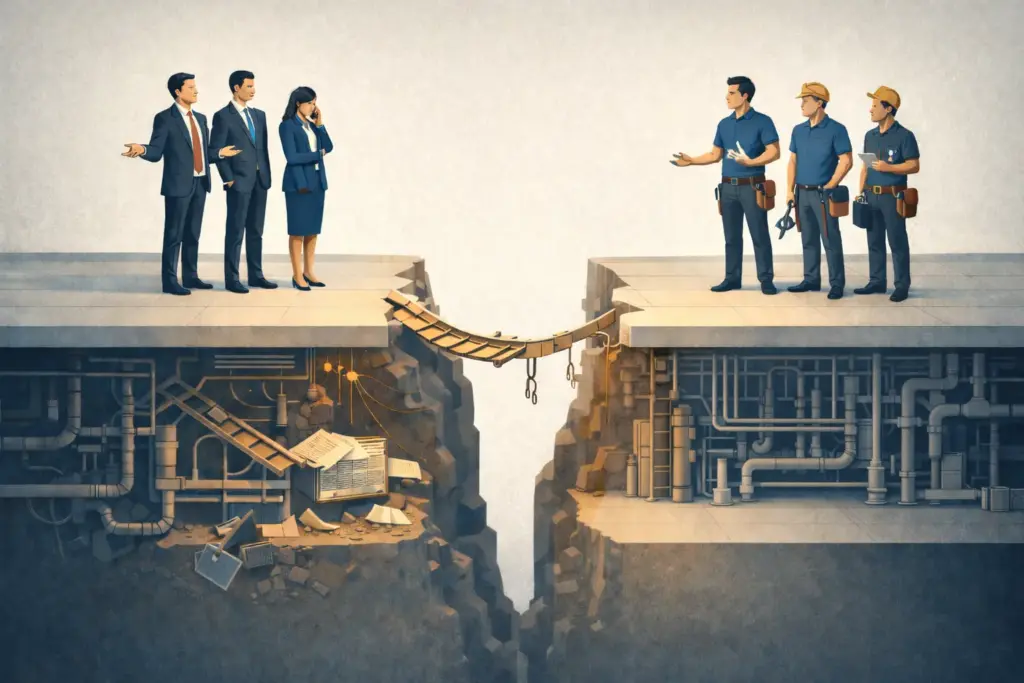
The public story stays coherent while the company underneath it fragments. Sales knows what was promised. Operations knows what is hard. Finance knows what was billed. Leadership knows what the reports say. The customer knows what they were told.
Each view holds part of the truth. No one owns the distance between them.
That distance is where trust debt accumulates. A promise gets made because the organization looks capable of keeping it. When the operating system falls short, people compensate, and their success keeps the gap invisible. That clears the way for the next promise under the same conditions.
The rescue becomes evidence that the model works. It should have been evidence that the model required rescue.
This is why untrustworthy organizations do not always look untrustworthy. They can be responsive, experienced, and genuinely good at making customers feel safe. The risk is not that the reassuring person is lying. It is that the company behind them cannot carry the reassurance forward without another rescue.
A trustworthy organization does not depend on one person’s ability to make uncertainty feel controlled. Ownership stays clear after the call ends. Context is available to the people doing the work. Commitments can be traced into decisions, actions, and outcomes.
The reassuring person is still valuable. They are just no longer standing in for the entire company.

“What you seem to be, be really.” - Benjamin Franklin
The Hero Subsidy
The company behind the contract does not hold together on its own. The gap between promise and capability has to be absorbed somewhere, and usually it is absorbed by the people who care most about the outcome.
They notice when ownership is unclear, when a commitment is drifting, or when the customer is about to discover something the organization should have caught earlier. They step in because letting the failure run would hurt someone, damage the relationship, or create more work later.
This is the hero subsidy: the hidden labor that enables an organization to sell outcomes it cannot reliably produce through ordinary operations. The company collects revenue, reputation, and renewal. A few conscientious people absorb the ambiguity, urgency, and emotional cost of keeping the promise intact.
From the outside, the result looks ordinary. A customer gets an update. A deadline slips but does not collapse. An incident is contained before it becomes visible. A hard conversation ends without the relationship breaking.
Behind those outcomes are hours of reconstruction, negotiation, escalation, and quiet correction that never touch the official process.
The company records the result. It rarely records the rescue.
That is how exceptional effort gets mistaken for operational capability. Leadership sees that the customer stayed, the project landed, or the issue closed, and reads it as proof the organization can carry the work.
The people closest to it know the result came from someone remembering what the system forgot, crossing a boundary no one owned, or accepting responsibility that was never formally assigned. The organization did not reliably produce the outcome. A person did.
At first, this looks like healthy initiative, and some of it is. Strong employees should exercise judgment, help each other, and step outside narrow roles when the situation calls for it. No working company eliminates improvisation entirely.
The distinction is frequency. A hero solves an exception. A subsidy supports the ordinary operation of the business.
When the same people repeatedly repair handoffs, recover commitments, and translate between disconnected teams, the effort is no longer exceptional. It has become part of the operating model, whether or not the model admits it.
The company starts planning around their willingness to compensate. Timelines assume someone will find a way. Sales commitments assume delivery will absorb the complexity. Work gets assigned according to who can be trusted to rescue it rather than whether the system is built to support it.
The most capable people end up with the least protected capacity because their competence makes them look endlessly expandable. The person who quietly prevents failure is handed more failures to prevent. The person who remembers an account becomes responsible for remembering all of them. The person who can calm a difficult conversation becomes the destination for every relationship at risk.
The organization concentrates responsibility in the people already carrying too much, then treats their continued performance as proof that capacity exists. What exists is personal tolerance, and personal tolerance is finite.
The subsidy is not measured only in hours. It consumes attention, judgment, emotional energy, and credibility. People carry problems home because they know what happens if no one keeps thinking about them after the meeting. They soften explanations because the full internal story would damage trust. They make commitments carefully because they may be the ones forced to keep them.
That produces an ethical strain that is hard to describe from inside the organization. The employee is not usually being asked to lie. They are being asked to represent a level of control they do not fully believe exists.
They reassure the customer while privately knowing that ownership is fragmented, specialists are overloaded, or the same failure has already happened three times. Their credibility becomes the bridge between the company’s claim and the customer’s experience, and every time that bridge holds, the company borrows a little more.
This is why retention can mislead. A customer may renew because the organization is performing well. They may also renew because switching is painful, the risk has not surfaced yet, or one trusted person keeps the relationship working.
Leadership sees the renewal and credits the company. The customer may be renewing the person.
The distinction stays hidden until that person leaves, changes roles, or simply stops compensating. Then the relationship comes apart quickly, and everyone acts surprised that so much trust left with one employee.
It did not disappear. It was never institutionalized.
The same pattern appears internally. A process looks stable until the person running it takes a vacation. A system looks documented until someone unfamiliar with it has to make a decision. A service looks profitable until the hidden escalation labor is counted.
The company learns what it actually owns only when the person carrying the missing structure is gone.
Conscientious people often stay longer than the system deserves because they feel responsible for the customers, coworkers, and outcomes that would suffer if they walked away. Their loyalty is to the work and the people it touches, not to the operating model consuming them.
That loyalty can be mistaken for consent.
There is a harder truth underneath this. Heroes can preserve the very systems that exhaust them. Each rescue protects the customer and keeps the organization from seeing the full cost of its own design. The failure is contained before it reaches the point where staffing, ownership, or priorities might finally change.
Competence becomes camouflage.
None of this means capable people should allow avoidable harm to happen just to prove a point. It means repeated rescue has to be treated as evidence, not success.
A mature company asks why the effort was necessary at all. What context was missing? Which decision had no owner? What has to change so the next person does not need the same memory, influence, or sacrifice?
It turns the rescue into structure. It captures what was learned, clarifies ownership, adjusts capacity, and removes the dependency that forced the improvisation.
It does not celebrate the firefighter and leave the building flammable.
Strong people will always matter. Their judgment, care, and willingness to act are part of what makes an organization trustworthy. But they should reinforce the system, not stand in for it.
The hero subsidy begins when a company needs extraordinary people to keep ordinary promises. It ends when the company can keep those promises without consuming the people who care enough to rescue them.
“The reward for work well done is the opportunity to do more.” - Jonas Salk
The Black-Box Advantage
The customer rarely sees how the work is produced. They see the outcome, the explanation, and whatever evidence the company chooses to provide: a report, a certification, a completed project, a familiar point of contact, a problem that appears to have been resolved.
They do not see the operating conditions behind it. They cannot easily tell whether the work moved through a repeatable system or depended on one person remembering what everyone else forgot, whether a deadline was met through ordinary capacity or through a week of escalation, overtime, and priorities quietly abandoned elsewhere.
This is the black-box advantage. The organization knows more about its internal condition than the people depending on it. Some of that imbalance is unavoidable. Customers hire outside companies precisely because they cannot inspect and manage every part of the work themselves, and the provider is expected to absorb the complexity and hand back something understandable.
The problem begins when simplification becomes concealment.
A mature company reduces complexity without distorting it. It explains what matters, surfaces the uncertainty that bears on a decision, and separates a stable outcome from one that required extraordinary intervention.
A weak company shows the same visible result and leaves out the conditions that produced it. The customer sees completion; the company knows it was a rescue. The customer sees responsiveness; the company knows the issue sat untouched until someone important noticed.
Both descriptions may be factually true. Only one describes the system.
This is why low-trust organizations stay convincing for so long. Buyers rarely have access to staffing realities, internal disagreements, undocumented dependencies, deferred maintenance, or the gap between a control that exists in policy and one that survives daily use.
So they rely on proxies: brand, certifications, references, financial stability, executive confidence, retention, formal reporting, and the apparent competence of the people in the room. Those signals are not meaningless. They simply answer narrower questions than buyers assume.
A certification shows that a defined set of controls held up within a stated scope and period, not that every promise is owned or every service can be delivered under pressure. A reference shows that one customer had a good experience, not how much effort, timing, or institutional memory it took to produce it. Retention may signal satisfaction, or it may signal switching costs, thin alternatives, and one trusted person keeping the relationship intact.
Financial health has the same limit. It proves the company can stay in business. It does not prove the company can carry the responsibility it keeps selling.
Financial statements record revenue, cost, debt, cash, and assets. They do not show the operational balance sheet: commitments with no clear owner, knowledge concentrated in a few people, controls assumed but never tested, maintenance repeatedly deferred, and risks carried forward because no one has the capacity or authority to close them.
That balance sheet also holds customer patience already spent and employee credibility already drawn down. Those liabilities are real whether or not the accounting system has a line for them.
So an operationally insolvent company can look healthy for years. Revenue continues because the promises still sell. Customers stay because the failures have not yet crossed their tolerance. Employees keep compensating because they care about the consequences.
Meanwhile, the liabilities accumulate quietly. Every unresolved dependency makes the next change harder. Every overloaded expert gets harder to replace. Every workaround becomes one more thing the company has to remember with nowhere reliable to keep it.
The debt is never called all at once. It is paid in small amounts by many people: a delayed response, another late night, a customer accepting one more explanation, an employee deciding it is still easier to fix the issue personally than confront the system that produced it.
The black box protects this accumulation because each audience sees only a slice. Customers see the relationship. Employees see their function. Executives see summaries. Finance sees performance. Auditors see the scope presented to them.
Each view can be accurate inside its own boundary. The distortion begins when one slice is mistaken for the whole.
Leadership is especially exposed because a large organization cannot be run through direct observation. Information has to be compressed as it climbs. Incidents become trends, exceptions become categories, and the texture of daily operation becomes metrics, status colors, and summaries.
Compression is necessary, but it strips out the friction that would otherwise signal where reality has stopped matching the story. A customer concern becomes “managed.” An overloaded specialist becomes “a capacity issue.” A recurring breakdown becomes “an opportunity to improve process.”
None of it is quite false. It just sands the condition down until it fits the narrative already in place.
Eventually, the organization begins managing its representation of reality instead of reality itself.
This does not require coordinated deception. In a fragmented company, no single person may have enough visibility to assemble an honest account of the whole. Each team reports its part. Leadership stitches the parts into a story. The story becomes more complete than the knowledge beneath it.
The company is not necessarily hiding the truth. It may no longer hold it in one place.
That is the most dangerous form of the black-box advantage because a company can mislead customers while nearly everyone inside it remains sincere. The confident explanation may rest on a report that dropped the exception, a metric that ignored the recovery effort, or a process that exists on paper and gets bypassed in practice.
The customer is left judging not only whether the evidence is real, but whether it supports the conclusion drawn from it. A polished report proves activity occurred, not that the condition improved. A successful recovery proves capable people responded, not that the organization is resilient. A stable relationship proves trust remains, not that the company still deserves it.
Traditionally, buyers had little choice but to accept the arrangement. Independent verification was expensive, fragmented, and usually triggered only by a failure, dispute, or formal investigation.
By the time the customer could see inside the box, the cost of what had accumulated there was already theirs.
That advantage is beginning to weaken. The box does not disappear; every organization contains more complexity than an outsider can fully inspect. But the company behind the contract is becoming easier to compare with the story told in front of it.
“What you see is all there is.” - Daniel Kahneman
Verification Moves Left
For most of business history, verification arrived late. The customer found the gap after a missed deadline, a failed control, a security incident, or a relationship already past repair. By then, the contract was signed, the money had been spent, and the provider’s internal problems had become the customer’s operational risk.
The old advice was to trust but verify. In practice, most people had to trust first and verify after the damage.
That sequence is starting to change.
In engineering and security, moving something left means addressing it earlier, before defects become expensive and risks reach production. Verification is moving left in the same way, shifting from a reaction to failure into something that can happen during evaluation, onboarding, delivery, renewal, and ordinary oversight.
Customers still do not need to understand every system they depend on. They need a better way to test whether the story matches the record.
For years, the provider controlled most of the information used to judge its own performance. It did the work, chose the metrics, wrote the report, and explained the result. Even an honest company interpreted itself through evidence it selected and language it understood better than the buyer did.
The customer could question the conclusion, but rarely had the time, access, or expertise to reconstruct the history behind it.
AI is lowering that cost. Not because it knows the truth. Models misread incomplete records, reinforce bad assumptions, and produce confident answers from weak evidence. No amount of processing turns bad information into reality.
What AI can do is compare more context than a person could hold at once. The contract can sit beside the delivery history, the policy beside the operating record, and the reported improvement beside the evidence behind it. Meeting notes, incidents, invoices, project plans, staffing changes, recommendations, and unresolved decisions no longer have to remain isolated in separate systems.
Once those records can be read together, sharper questions become possible. Which commitments recur without an owner? Which risks keep changing their language without changing their condition? Which controls exist in policy but leave no trace of ordinary operation? Which improvements reflect a stronger system, and which reflect one capable person recovering the same failure again?
These are not questions about whether activity occurred. They are questions about whether capability exists.
That distinction is what low-trust organizations cannot survive because they usually have plenty of evidence: reports, meetings, tickets, policies, plans, and metrics. The problem is that the information remains fragmented enough to support several incompatible stories at once.
Leadership sees progress. Operations sees recurring exceptions. Finance sees healthy revenue. Customers see responsiveness. Each view rests on real evidence, yet none describes the whole system.
Verification moves left when those views can be set against one another before one of them collapses.
The goal is not total surveillance or access to every private conversation. It is enough visibility to tell whether important claims have corresponding owners, decisions, actions, and outcomes.
A company says a risk is being managed. What changed? A control is described as operational. What shows it survives ordinary use? A recurring issue is called an exception. How many times has it happened? A service is called strategic. Which decisions came out differently because of it?
Those questions were always available in theory. What changes now is the speed and cost of asking them across a large body of evidence.
This reaches beyond customers. Employees will weigh stated values against repeated decisions. Investors will test whether growth is supported by operating capacity. Insurers, regulators, and partners will verify whether formal claims align with actual behavior.
Organizations will not be the only ones deploying intelligent agents. The people evaluating them will bring their own.
That does not have to make every relationship adversarial. Verification can protect a trustworthy company by preserving the history behind its decisions and tradeoffs. It can show when a provider raised a risk, when a recommendation was declined, or when a delay resulted from something outside the provider’s control.
Evidence is not only an instrument of accusation. It is protection against an incomplete story.
Weak organizations will answer with more theater. The same tools that make comparison easier can also produce cleaner reports, smoother summaries, and explanations shaped around whatever the audience wants to hear.
AI can scale verification, and it can just as easily scale the appearance of control.
A polished answer is not a verified answer. The difference lies in whether the explanation traces back to evidence, whether uncertainty remains visible, and whether the reported outcome holds up against what happened next.
This is where Actual Intelligence matters. It is not a machine producing a more convincing interpretation. It is context tested against reality: what was expected, what happened, what evidence supports the conclusion, how confident we should be, and what changed because of what was learned.
Without that loop, AI becomes one more layer between the organization and the truth. With it, verification becomes part of how the organization operates rather than an event imposed from outside.
That requires companies to preserve more than final outcomes. They must retain the reasoning behind decisions, the ownership behind commitments, the evidence behind controls, and the record of whether recurring failures ever led to real change.
The best-prepared companies will not be the ones claiming to have removed uncertainty. They will be the ones that can show where uncertainty lives and how it is being handled.
The advantage is shifting. It once belonged to the company that controlled the story. It will increasingly belong to the company whose story survives comparison.
“The sole test of the validity of any idea is experiment.” - Richard Feynman
Trust That Survives Inspection
Inspection is often read as evidence that trust has already failed. A customer asks for proof, leadership stiffens, and reasonable questions about ownership, capacity, controls, or outcomes start to sound like accusations. The relationship was supposed to run on confidence.
That reaction is the tell. Trustworthy organizations do not need the customer uninformed. They may limit access to sensitive information, push back against a wrong conclusion, or explain why a request creates more risk than value. What they do not need is distance from the evidence. Trust that depends on distance is not strong trust. It is untested trust.
Confidence can start a relationship. Evidence is what lets it survive pressure. Customers do not need every internal disagreement or operational detail. They need enough visibility to know whether the organization can carry what it accepted.
Can it name who owns a commitment, show that the work happened, and explain how risk surfaces when conditions change? Does knowledge survive turnover? When something fails, does the system change, or does another capable person quietly recover it and leave the design untouched?
These questions do not demand perfection. They demand coherence.
An operationally solvent company still misses deadlines, loses people, experiences incidents, and makes decisions that turn out to be wrong. Solvency is not the absence of failure. It is the ability to absorb failure without collapsing into concealment, improvisation, or extraordinary sacrifice.
The company knows what it owns and where its limits are. It can tell a temporary exception from a recurring condition. When capacity is short, the shortage becomes part of the decision instead of something the frontline is expected to absorb in private.
That changes how promises get made. A solvent company does not treat every opportunity as revenue waiting to be booked. It asks whether the service can be delivered consistently, whether the knowledge actually exists, and whether the people accepting responsibility have the authority and capacity to carry it out.
Sometimes the answer is no. Sometimes it is not yet. Those answers look less impressive in the moment, but they keep the company from financing growth with commitments it cannot support. A trustworthy organization would rather disappoint a prospect than quietly hand its weakness to a customer.
The same discipline holds after signing. Commitments stay attached to owners. Decisions keep enough context to be understood later. Risks are assigned, accepted, reduced, or consciously carried forward. The system keeps a memory of what happened.
That memory matters because evidence without context creates its own theater. A completed task proves that an action occurred, not that the condition improved. A control can exist and still be routinely bypassed. A clean recovery can demonstrate excellent judgment while hiding the fact that the same failure should never have recurred.
Inspection earns its value when the record connects to the result: what was expected, what happened, what changed afterward, and what suggests the change will hold.
A trustworthy company can say, “We do not know yet,” without treating uncertainty as weakness. It can explain what is understood, what remains unverified, and what evidence will determine the next move.
Low-trust organizations struggle with that language because certainty is part of what they sell. Unknowns are softened until they sound manageable. Constraints are discussed internally and edited out of the customer-facing story. Risks are acknowledged without anyone holding the authority to act on them. The explanation stays calm while the condition stays exactly where it was.
Trust that survives inspection does not require uncertainty to vanish. It requires uncertainty to be represented honestly enough that people can make decisions around it. That may mean telling a customer the original timeline was never realistic, a control was weaker than everyone believed, or the company cannot deliver everything it sold at the same time.
Those conversations may cost trust in the short term, but they preserve it over time. Customers do not expect perfection. They expect enough information to protect their own interests. A problem disclosed early can be planned around. The same problem hidden until failure tells the customer that the organization protected its own appearance at their expense.
Trustworthiness is not only about answering honestly when asked. It is about surfacing what a reasonable person would want to know before the question becomes urgent.
A trustworthy company does not wait for the customer to find the contradiction. It brings the contradiction into the room.
Inspection protects the good company too. A shared record can show that a risk was raised, a recommendation was declined, or a delay resulted from a decision outside the provider’s control. It separates negligence from a conscious tradeoff and preserves the context behind an imperfect outcome.
Without that history, every disagreement becomes a contest of memory. The customer remembers the promise, the provider remembers the caveat, the people involved have moved on, and the evidence is scattered across systems never built to preserve a decision. Trust collapses into whichever story sounds more credible.
A mature organization does not rely on credibility alone. It builds the record while the context still exists, not to avoid accountability, but to make accountability accurate.
That begins inside. Leaders need access to the conditions beneath the summary. Teams need a way to raise recurring exceptions without every report becoming an exercise in self-defense. The people closest to the work need standing to challenge the story when it stops matching the system.
Otherwise, transparency becomes another performance: evidence assembled for an audience by a company that remains unable to learn from it.
A trustworthy organization is not merely transparent when inspected. It is inspectable by design.
Important claims leave a trail. Ownership is identifiable, decisions keep their rationale, and failures produce changes that remain visible afterward. Critical knowledge does not stay permanently trapped in one person simply because that person has always been available.
This is not a demand to measure everything. More data is not more truth, and constant measurement creates its own theater. It means the claims that matter can be tested.
If a risk is managed, the company can show what was done and what remains. If a service is strategic, some decision should be different because of it. If a recurring problem is fixed, the next occurrence should not depend on the same person performing the same rescue. The standard is not whether the organization can produce a report, but whether the system behaves differently because the report exists.
This is where operational solvency becomes visible. Strong people still matter, but the company no longer consumes them to protect every outcome. Customers may trust individual employees, yet the relationship does not collapse when one of them leaves because the trust has somewhere else to live.
It lives in clear ownership, durable knowledge, honest constraints, tested controls, and evidence that the organization learns. It lives in the alignment between what the company says, what its people experience, and what the record supports.
That alignment will never be perfect. The goal is not to eliminate every gap between the story and the system, but to keep the gap visible enough that it cannot quietly become the business model.
Low-trust companies will continue to sound confident. They will buy better tools, produce cleaner reports, and use AI to make fragmented work appear more coherent than it is. That may extend the performance, but it will not retire the debt.
The companies that endure will not need opacity to protect their value. Their internal reality may be complicated and sometimes uncomfortable, but it can survive comparison with the story told outside. They will not ask customers to choose between trust and verification because they understand that verification is how trust becomes durable.
The future does not need less trust. It needs trust that can survive inspection.
“Sunlight is said to be the best of disinfectants.” - Louis D. Brandeis