Everyone is talking about vibe coding.
Some treat it like a movement. Others see a threat, a shortcut, or another temporary wave of hype. The answer usually depends on where they sit.
Founders love it because the distance between an idea and something visible has collapsed. They can finally see what they have been trying to describe without waiting months, translating every thought through several people, or committing a large budget before knowing whether the idea makes sense.
Developers are split. Some are leaning in and moving faster than ever. Others are asking reasonable questions about security, durability, and maintenance, while quietly wondering who will have to clean up what gets built too quickly.
Product teams feel the change differently. The backlog used to be the bottleneck. Now the bottleneck is clarity. Something can be built before the team has fully decided what it is, who it serves, or how it should behave when the happy path ends.
Customers do not care how any of this works. They only feel the outcome: products that almost work, roadmaps that almost land, and promises that almost materialize.
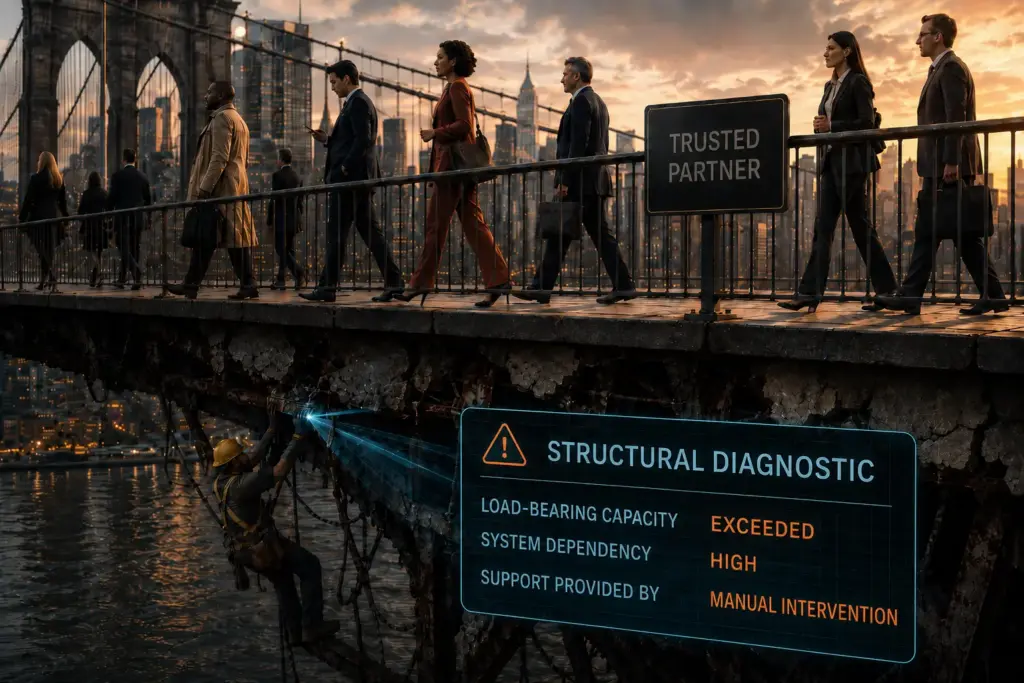
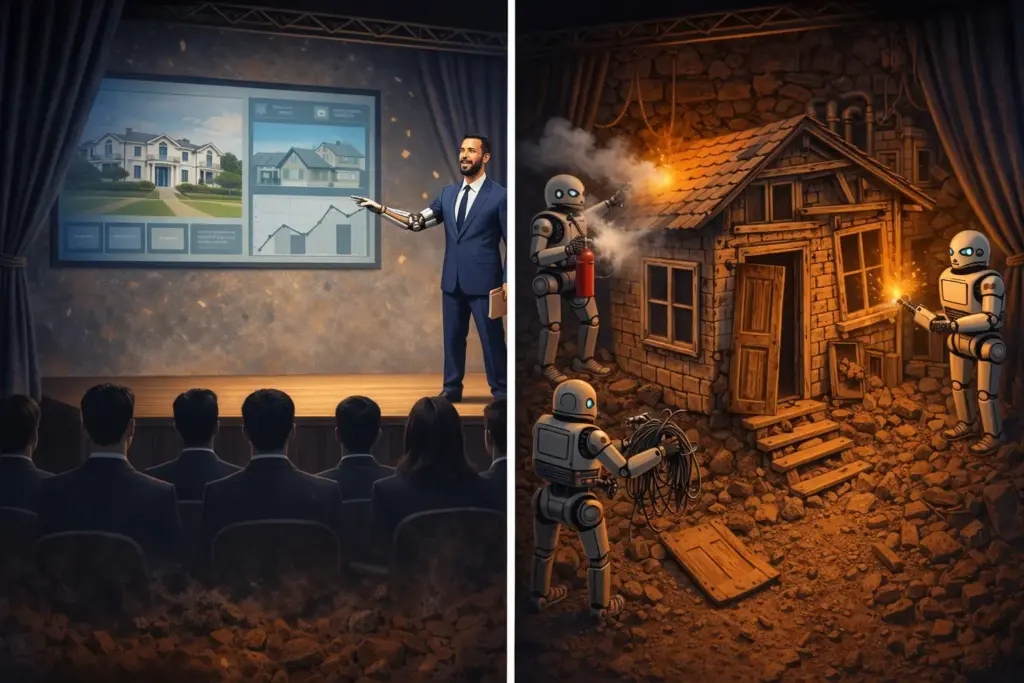
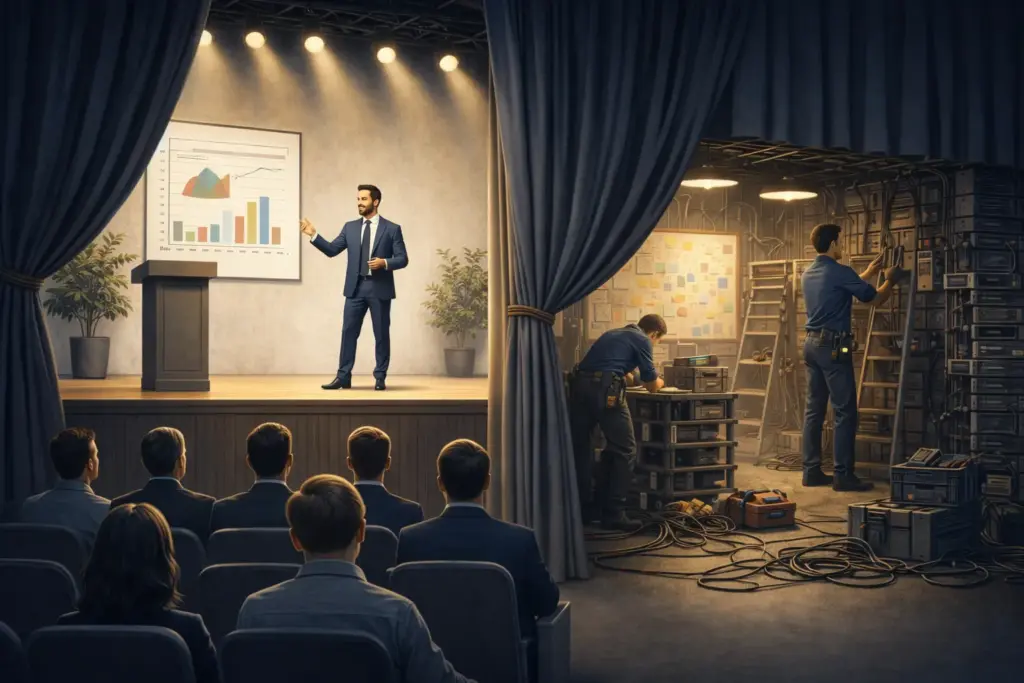
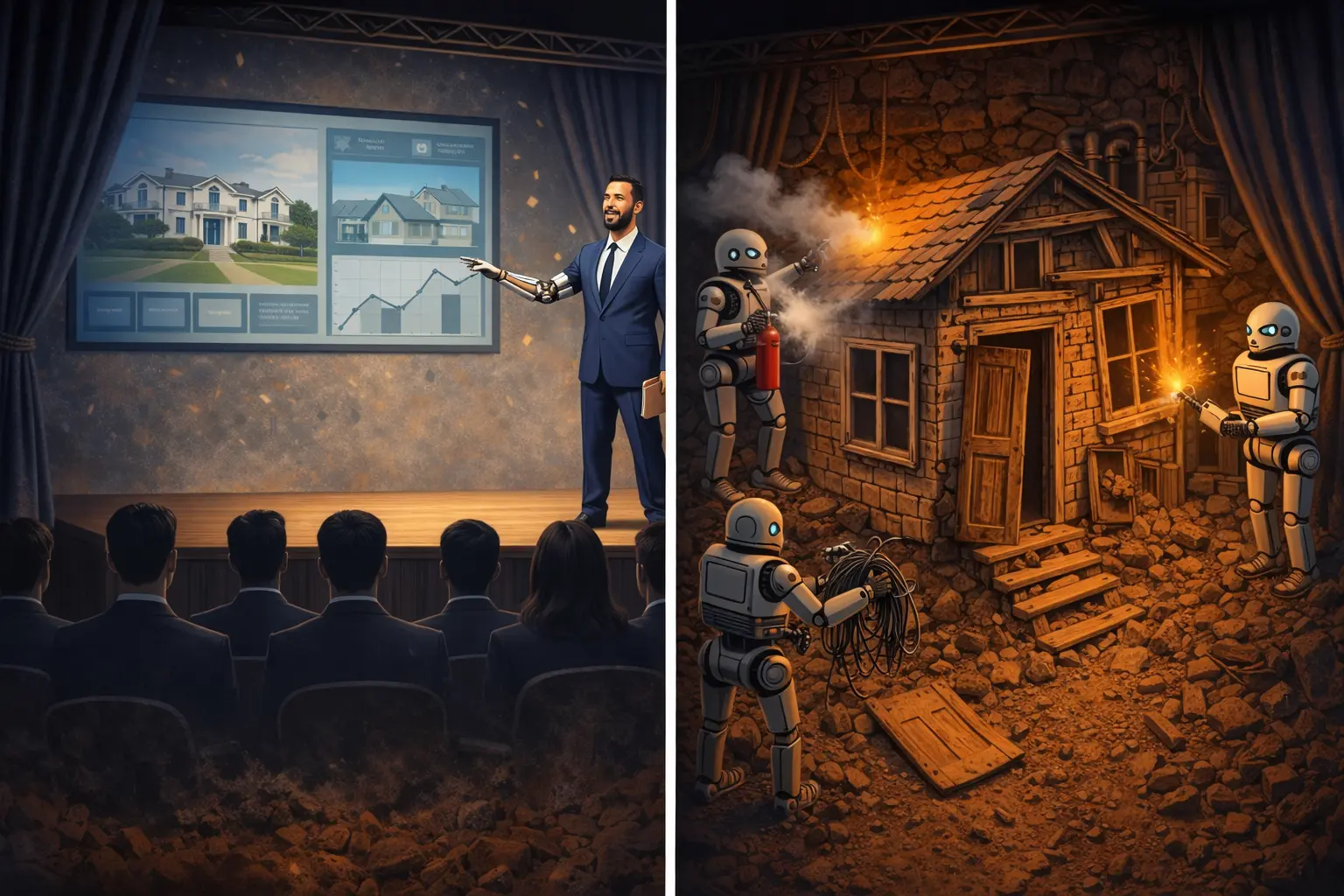
Modern SaaS already had a theater problem. Vibe coding did not create it.
It made the set cheaper to build.
The interface can now arrive before the product, the product before the system, and the system before anyone has decided who owns what happens next. That is why the public conversation still feels shallow.
Is vibe coding real? Of course it is. Is it dangerous? It can be. Is it the future? It is already part of it.
None of those questions tell us whether the resulting software is any good.
The real shift is not how code gets written. It is who can shape the system, and who owns the result when that system meets reality.
The Cost of Not Owning the Build
I thought writing the software would be the hard part. It was difficult, but it was not what trapped me.
The handoff did.
I was giving the work to people who did not own the outcome, did not understand the whole system, and did not experience the cost of being wrong. I would ask for a portal, and we would spend days on a password reset before reopening the question of what belonged on the login page. Basic components were rebuilt because each request was treated as a separate assignment rather than part of an existing product.
There was no modular thinking, no reuse, and no shared understanding of what mattered.
I was not paying for outcomes. I was funding attempts.
The deeper the project went, the more obvious the gap became. Sometimes a solution was copied from something similar without anyone understanding why it worked. Other times, core decisions were pushed back to me because someone needed to approve them.
Architecture, authentication, data structure, and system behavior were not cosmetic choices. They would determine how the product operated, how it failed, and how difficult it would be to change later.
I was being asked to make decisions I was not equipped to make. Then, when something broke, the decision became the explanation rather than the implementation or execution.
The problem was traced back to the person who should never have been responsible for making the decision in the first place.
There was always a reason the work was not ready. It needed more testing. The requirement was more complicated than expected. The team needed another week.
Testing mattered, and complexity was real. But those explanations were often being used to rename unfinished thinking as temporary delay.
Most of the time, the problem was not a bug.
It was ambiguity that had survived all the way into code.
That is what wears you down. Not only the money or the delay, but the illusion of progress. There are commits, meetings, and something new to click, yet the product is no closer to being dependable.
Weeks become months, and months become resets. Each reset creates more dependence because walking away means discarding incomplete work, while staying means increasing your reliance on the same people and the same process.
So you stay.
Now the product sits behind someone who has been asked to think in tasks rather than outcomes. The problem is not that they cannot code. It is that no one has been given responsibility for the product as a whole.
A product cannot be owned through a ticket queue.

“What you do not understand, you do not own.” - Johann Wolfgang von Goethe
The Patchwork Illusion
Patchwork does not begin as failure. It begins as visible progress.
A login page appears, then a dashboard, then a workflow connected to another workflow. Each piece works well enough to demonstrate, so the product feels as though it is moving forward. Technically, it is. There is code, there are commits, and there are screens someone can click through.
The problem sits underneath the visible product. Each feature may carry its own assumptions, naming, logic, and way of handling failure. The parts exist, but they do not necessarily belong to the same system.
That is the patchwork illusion. Something looks like a product because it has the expected surfaces, while behaving like a collection of unrelated decisions.
Each decision may be reasonable in isolation. The trouble begins when those decisions have to coexist. One workflow assumes a user has a single role while another assumes several. One feature treats a failed action as temporary while another treats it as permanent. One part stores data according to an existing model, and the next invents a new one.
Complexity is not always what makes software fragile.
Inconsistency does.
A complicated system can still be understood when its rules are coherent. A smaller system becomes difficult to maintain when every feature introduces a new set of rules.
AI can accelerate this problem because it is very good at producing local completion. Ask for a screen, endpoint, or workflow, and it can produce something plausible quickly. But a plausible component is not automatically a coherent addition to an existing system.
Someone still has to understand why the rest of the product works the way it does, which patterns must remain consistent, which shortcuts are temporary, and which decisions will become difficult to reverse. That context does not appear automatically. Someone has to hold it.
Without that ownership, every new feature expands the surface area for failure. Changes slow down because each step forward requires understanding the assumptions behind everything already built, and eventually no one does.
The codebase becomes a negotiation with its own history. A simple change touches several unrelated decisions. Fixing one behavior breaks another. People become afraid to remove anything because no one knows what depends on it.
The product is still being built, but it is not becoming more complete.
That is where products stall. Not always at the idea, the funding, or the market.
At the structure.
“We don’t see things as they are, we see them as we are.” - Anaïs Nin
The Four Perspectives
Everyone sees a different version of the same system. Each perspective is valid from where they sit, but none captures the whole thing.
The Founder
The founder wants movement. They have been carrying an idea, trying to explain it, fund it, and turn it into something other people can understand. Vibe coding shortens that distance. For the first time, they can change something directly and see the result.
That is powerful, but it also makes it easy to confuse visibility with validation. Seeing the product does not mean the product has been understood. A working screen does not prove that the workflow makes sense, the data model will hold, or customers will behave the way the founder expects.
The founder can test more ideas than ever. They can also become committed to an idea before the difficult questions have been asked.
The Product Manager
Product managers used to control a scarce resource. Development capacity was limited, so the backlog forced prioritization. Weak ideas could remain vague for months because no one had enough time to build them.
Now more of those ideas can be built immediately, which shifts the pressure from deciding what enters the queue to defining what should exist in the first place. That makes product work harder, not easier.
Unclear thinking no longer waits quietly in a backlog. It becomes software.
Sometimes it fails immediately. More often, it almost works, which is harder to diagnose because everyone can see enough progress to keep going.
The product manager’s job is no longer only to protect development time. It is to protect the product from unresolved thinking.
The Developer
Developers see the risks that remain invisible during a demo. They see code no one understands, permissions that were never designed, failure states no one considered, and systems that will eventually need to be operated by people who were not present when they were created.
Some developers are leaning into the tools and expanding what they can own. Others are resisting because they have seen what happens when speed outruns structure.
Not every concern is gatekeeping. Some developers are defending things customers notice only when they are missing.
At the same time, some resistance comes from an older model in which the ability to produce code created leverage. That scarcity is weakening. Both things can be true.
The real argument is not about whether AI should write code. It is about who remains responsible for understanding the consequences.
The Customer
The customer does not care whether the product was built by a large engineering team, a solo founder, or a model responding to prompts. They care whether it works.
Not only during the demo, and not only on the intended path. They care whether it works when an employee makes a mistake, a payment fails, a permission changes, data arrives in the wrong format, or the company needs to do something the original builder did not expect.
Most products do not fail completely. They almost work.
That means the customer has to finish them.
“Where you stand depends on where you sit.” - Rufus Miles
MVP Theater vs Real Value
At its best, an MVP was a narrow experiment designed to test the riskiest assumption with the least waste. It did not need to be polished, but it needed to produce an honest signal.
Now MVP often means little more than something that exists: a demo, a dashboard, or a workflow that looks complete enough to show and convincing enough to sell.
Minimum viable product becomes minimum viable appearance.
MVPs have not only become faster. They have become easier to fake because the visible parts of a product can now be built without solving the parts that determine whether it can survive.
Authentication works for the demo account. Permissions work as long as everyone behaves as expected. Data moves correctly until it needs to be corrected, restored, migrated, or explained.
The hard parts are rarely the screens. They are identity, permissions, data integrity, recovery, billing, monitoring, support, migration, and the long list of exceptions that appear when real customers use the product in ways no one planned.
Those problems are difficult to demonstrate, so they are deferred. The cycle becomes predictable: build quickly, show the product, sell the promise, and solve the system later.
Later is where the product becomes real, and where everything begins to break.
The demo was not necessarily a lie. It was an incomplete truth presented as proof.
The customer then finishes the product through workarounds, spreadsheets, manual checks, internal training, and habits created to compensate for what the software cannot do. They build processes around the gaps, and that effort is easily mistaken for adoption.
Workarounds look like engagement. Dependence looks like retention. Support volume looks like useful feedback. But the customer may not be staying because the product is good. They may be staying because leaving would require rebuilding the system they created around it.
That is not product value. It is operational captivity.
A real MVP can be small, ugly, and incomplete. It can serve one customer, one workflow, or one narrow use case. What it cannot do is misrepresent what has actually been solved.
A narrow product that works is more valuable than a broad product the customer has to hold together.
“Reality is that which, when you stop believing in it, doesn’t go away.” - Philip K. Dick
The Shift: From Builders to Product Engineers
There is a shift happening, but it is not only in the tools. It is in the people who become valuable when producing code is no longer the main constraint.
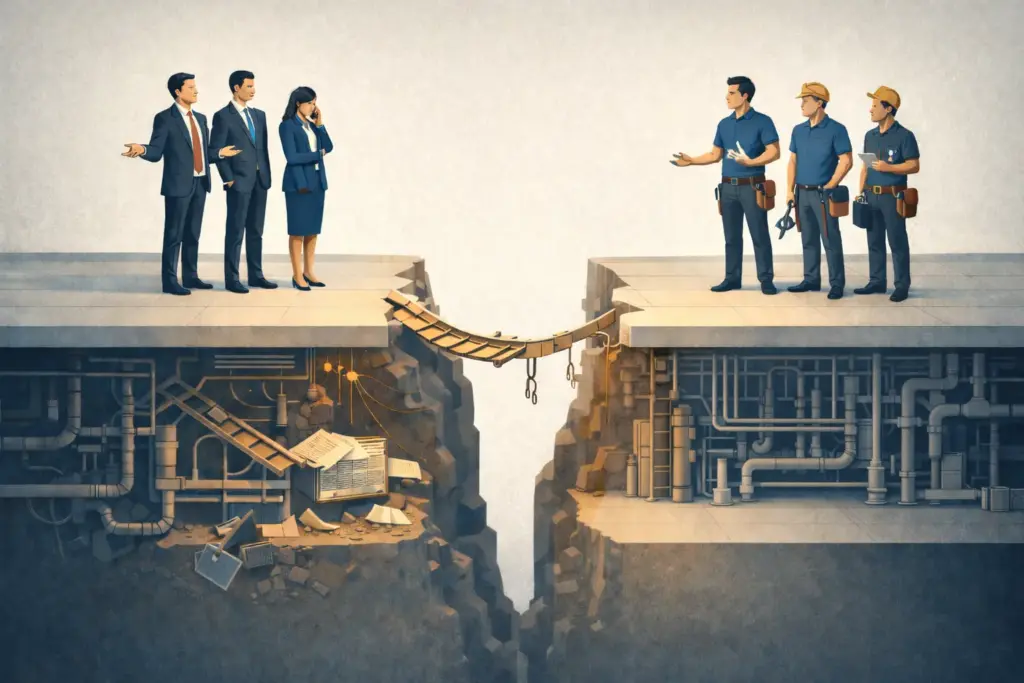
Software has traditionally been built through specialization. One person defined the requirement, another designed the interface, another wrote the code, someone else tested it, and operations inherited the result. Specialization itself is not the problem. The problem is what gets lost between each role.
At every handoff, context is compressed. The reason behind a decision becomes a requirement. The requirement becomes a ticket. The ticket becomes code. By the end, everyone may have completed their part while no one fully owns the outcome.
That model was easier to tolerate when building was slow. Each stage had more time to review, translate, and correct what came before it. Now software can move faster than the organization can understand it.
The bottleneck is no longer only implementation. It is deciding what should exist, how it should behave, and which consequences the team is willing to accept.
That changes what strong developers look like. The ones who stand out do more than complete the request. They ask what the user is trying to accomplish, how the new behavior fits the existing system, what happens when it fails, and who will have to maintain it later. They do not treat the ticket as the full truth. They refine it.
That is the product engineering orientation.
A product engineer is not someone who performs every role alone. They do not replace product managers, designers, security specialists, or operations teams. They keep the thread intact from the problem to the consequence.
They know when a prototype is disposable and when generated code is about to become infrastructure. They understand that a shortcut taken during exploration may become permanent the moment a customer depends on it.
AI changes their leverage, but it does not remove their obligation. The difference is not better syntax or faster output. It is the ability to move between user needs, product behavior, and system constraints without losing ownership along the way.
The shift is from executing tasks to owning outcomes. Specialization will remain, but fragmented accountability cannot.
“Responsibility equals accountability equals ownership.” - Peter Drucker
The Inevitable Future
This does not go backward. The cost of producing plausible software will continue to fall, and more people will be able to create interfaces, automate workflows, connect services, and turn ideas into something visible.
That is a good thing. It will also produce more software that looks finished before it has been fully considered.
The ability to build is not becoming worthless. It is becoming less valuable on its own. When many people can create something that almost works, the advantage shifts to those who can tell the difference between a demonstration and a product.
That requires understanding what should be built, which parts can remain temporary, how the pieces fit together, and what will happen when the system is placed under pressure.
The divide is not between people who use AI and people who refuse it. It is between people who understand systems and people who assemble surfaces.
AI does not eliminate engineering. It exposes which parts of engineering were code production and which parts were judgment. Some people will use that leverage to create more real value. Others will use it to produce more convincing failure. Both will move faster.
So do not kill the vibe. Use it to explore, build the prototype, shorten the distance between an idea and something you can test, and let more people participate in shaping the product.
But know what stage you are in.
Do not confuse a working screen with a working system, a customer’s willingness to compensate with product success, or the rehearsal with the finished performance.
Modern SaaS theater begins when the visible product gets ahead of the real one. The interface arrives before the system, the promise before the proof, and the customer before the organization is ready.
Build quickly, but be explicit about what is temporary, what is production, and who owns the consequences.
You can fake a product faster than ever.
You still cannot fake a system.
“The future is already here; it’s just not evenly distributed.” - William Gibson