Companies rarely lose their soul overnight.
They trade it away quietly.
The shift begins when stewardship is treated as inefficiency. Builders become resources to manage, experience becomes legacy thinking, and institutional memory becomes friction. Decisions move upward, away from the people who understand their consequences.
Nothing explodes. The company still sells, people still get hired, and leadership still presents a strategy. From the outside, the organization may even look more disciplined than before.
Inside, care is being converted into compliance.
The first people to notice are usually the elders. Not necessarily the oldest employees, but the people who carry the history. They remember why a process exists, where the system is fragile, which shortcuts became permanent, and what happened the last time someone tried to simplify the wrong thing.
They do not leave because they cannot adapt. They leave because adaptation has come to mean forgetting what they know.
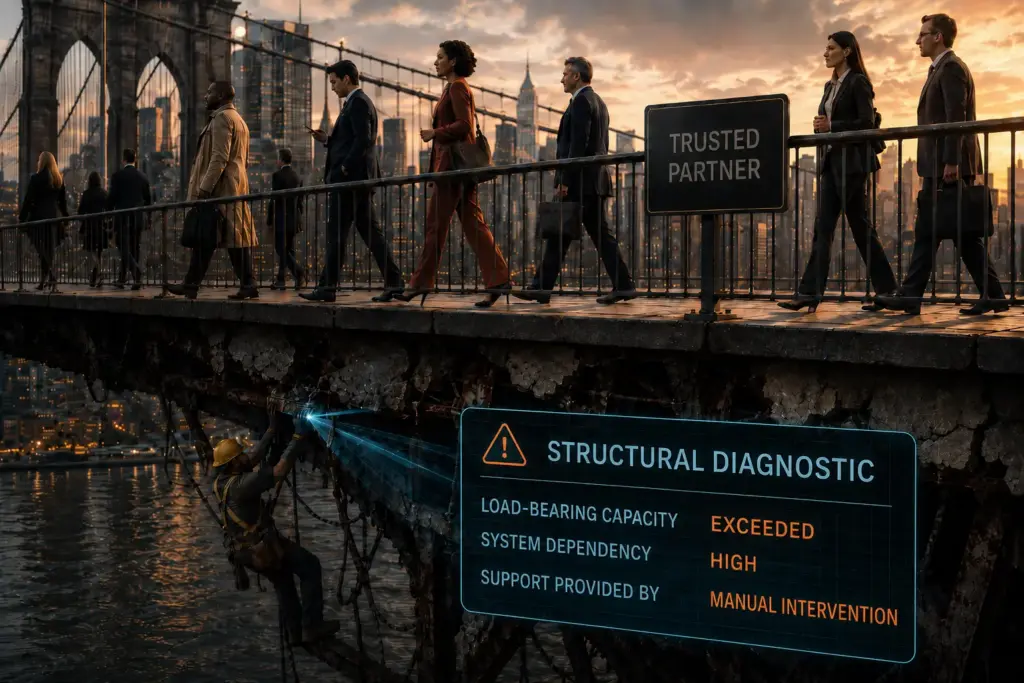
Then the people carrying the system begin to disappear. They are the ones who absorb incidents before customers feel them, protect the edges, notice weak signals, and understand how the organization works outside the official process. They know which systems only appear stable because someone is constantly compensating for them.
Their experience remains valuable during emergencies but inconvenient during planning. They are expected to catch the consequences without being included in the decisions that create them. Eventually, they stop warning people.
Then they leave.
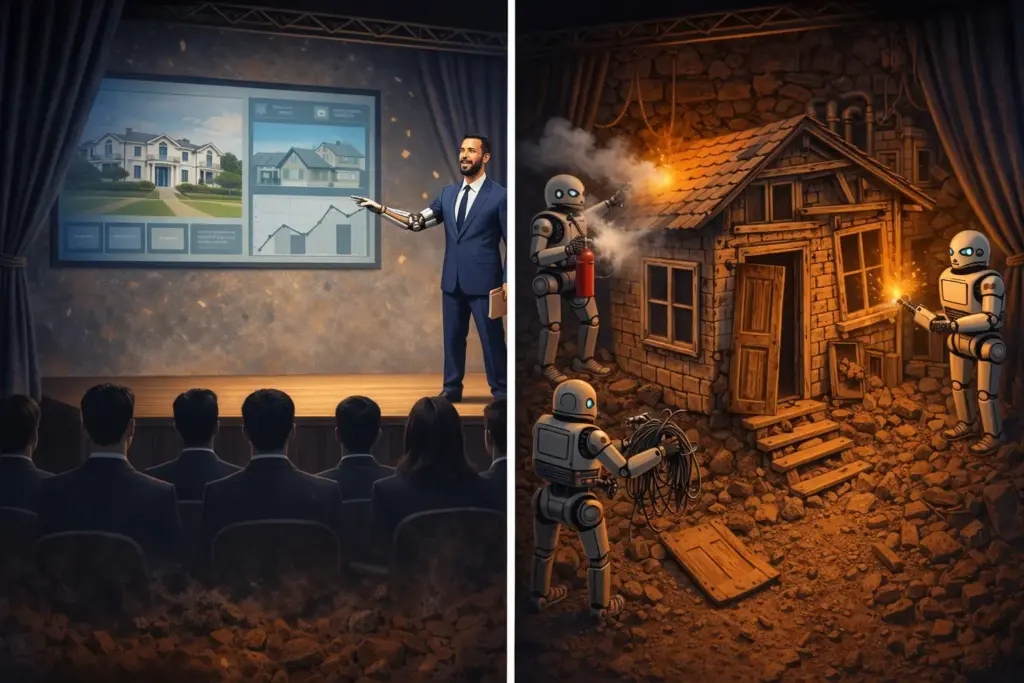
What follows is theater.
Meetings about meetings. Presentations about outcomes. Managers who speak fluently about work they have never performed and systems they do not understand. Leadership becomes performative, handoffs become ceremonial, technology becomes overhead, and security becomes optics.
Culture becomes a poster on the wall.
Everyone is busy, aligned, and strategic. Somehow, the actual work keeps falling on fewer shoulders.
That is how companies lose their soul. Not through malice, but through abstraction.
A company’s soul is not mystical. It is what people protect when no one is watching. It is how they respond when something breaks, whether craftsmanship still matters, and whether someone has the authority to stop work that should not continue.
It appears when builders care, elders teach, and the people closest to the system are trusted to exercise judgment. When those conditions disappear, the process remains, but the purpose does not.
What is left may still generate revenue, retain clients, renew contracts, acquire competitors, and grow headcount. But it is no longer held together by a shared sense of responsibility. It becomes a roll-up, a collection of clients, contracts, products, and teams assembled through spreadsheets.
The builders are gone. The elders have walked. Now the director’s chairs are full.
People who have never built anything call action. Scenes begin and end on command. The systems keep moving because enough people still remember what to do, and everyone continues going through the motions.
The craft is gone because ownership left with the people who carried it.
What remains is not a company.
It is a production.
From the Stuntperson’s View
Spend enough time inside companies and you begin to recognize the pattern. Different logo, different leadership, same system.
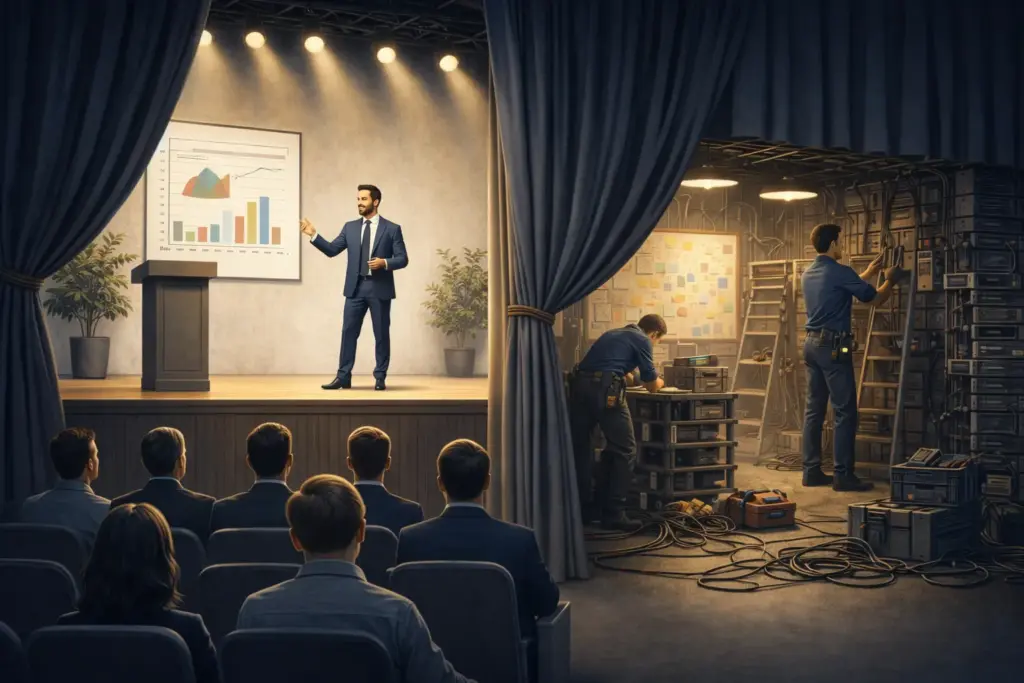
I have spent most of my career underneath it, not delivering the lines or calling the scenes, but keeping things running when the plan no longer matched reality.
It is a strange vantage point. You are close enough to understand how the company actually operates, but not high enough to control where it is going. You see decisions after the meetings are over, along with what those decisions require from the systems and the people expected to absorb them.
That is the stuntperson’s view.
The audience sees the finished scene. You see the wires, the resets, the rehearsals, and the number of people required to make an impossible sequence look routine. When it works, no one notices. When it fails, everyone asks what happened.
The first time a company repeats the same mistake, you assume someone made a bad decision. The second time, you assume communication failed. After enough cycles, you stop treating each failure as an isolated event and begin to see the structure producing it.
The people involved may be capable. Their intentions may be good, and the plans may sound reasonable when considered individually.
The outcome still repeats.
That is when you realize the problem is not one manager, one strategy, or one reorganization.
It is the system.

"The map is not the territory" - Alfred Korzybski
Reorganizing the Pattern
At first, every failure looks local: a bad manager, a confused strategy, an acquisition that never integrated, or a team that lacked the right people. You assume the next reorganization will fix it.
Then you watch the organization reorganize again. And again.
I watched one version of this unfold over more than a decade inside a large cybersecurity company as it moved through multiple ownership cycles: public, private, then public again. Each transition promised clarity, but each one added another culture without fully removing what came before it.
One office still operated as though the founders were in the room. Another carried the habits of a previous acquisition. A third functioned as though the company that created it no longer existed.
Officially, it was one organization. Operationally, it was several histories sharing a logo.
Acquisitions were constant. Each one brought new products, teams, partners, and overlapping platforms, and every announcement promised synergy. What followed was usually more complicated.
Customers did not buy synergy. They bought the product, relationship, or capability that already worked for them. Leadership saw opportunities to consolidate, while the people operating the systems saw dependencies, exceptions, and years of accumulated knowledge that did not fit neatly into a roadmap.
Eventually, leadership decided the future required a new platform: new architecture, new team, clean start. The existing system was classified as legacy, and the experience behind it was treated as attachment to the past.
The new team began without many of the people who had built, operated, and repaired the existing environment. They inherited diagrams and requirements, but not the history behind them. They knew what the system was supposed to do, but not what had taught it to behave that way.
The map changed. The territory did not.
While these larger transitions unfolded, the organization continued reorganizing underneath them. Over twelve years, I reported to nearly thirty managers. On Friday, you had one role. On Monday, you had another. Teams were moved, renamed, combined, and separated faster than the systems beneath them could change.
The organizational chart became a description of intent rather than reality. Work still followed the paths created by knowledge, trust, and capability. People went to whoever could solve the problem, regardless of where that person appeared on the latest chart.
During periods of rapid growth, hiring became a capacity exercise. Filling seats mattered more than preserving the standard that had made the organization successful. That solved an immediate problem and created a longer one.
Craft diluted. Coordination became harder. Experienced people spent more time correcting work, transferring context, and absorbing escalations. The burden moved downward.
The work still got done, but not because the system had become more effective. People stepped in. They worked late, joined escalations, repaired failed handoffs, and improvised around plans that did not match the environment.
Their effort protected the company from seeing the full cost of its own decisions.
This is one reason structural problems survive. The people most capable of recognizing the failure are often the same people preventing it from becoming visible. Their competence makes the system appear healthier than it is.
After enough cycles, you stop calling this an anomaly.
Scale and valuation do not automatically produce this outcome, but they make it easier to rationalize. Growth rewards expansion before integration. Ownership changes reward visible transformation. Leadership is pressured to create a new story even when the organization has not finished absorbing the last one.
The logo changes.
The pattern remains.
“Organizations which design systems are constrained to produce designs which are copies of the communication structures of these organizations.” - Melvin E. Conway
Choosing Stewardship
After enough time inside these systems, you stop asking how to fix every organization. You start asking whether you want to build one the same way.
Around that time, I had begun working on something of my own: small prototypes, operational experiments, and tools shaped by the gaps I kept seeing in real environments.
The first observation was simple. When people encounter a real problem, they do not think in portals, service catalogs, departments, or support tiers. They usually do not know which system owns the issue or which team is responsible for handling it.
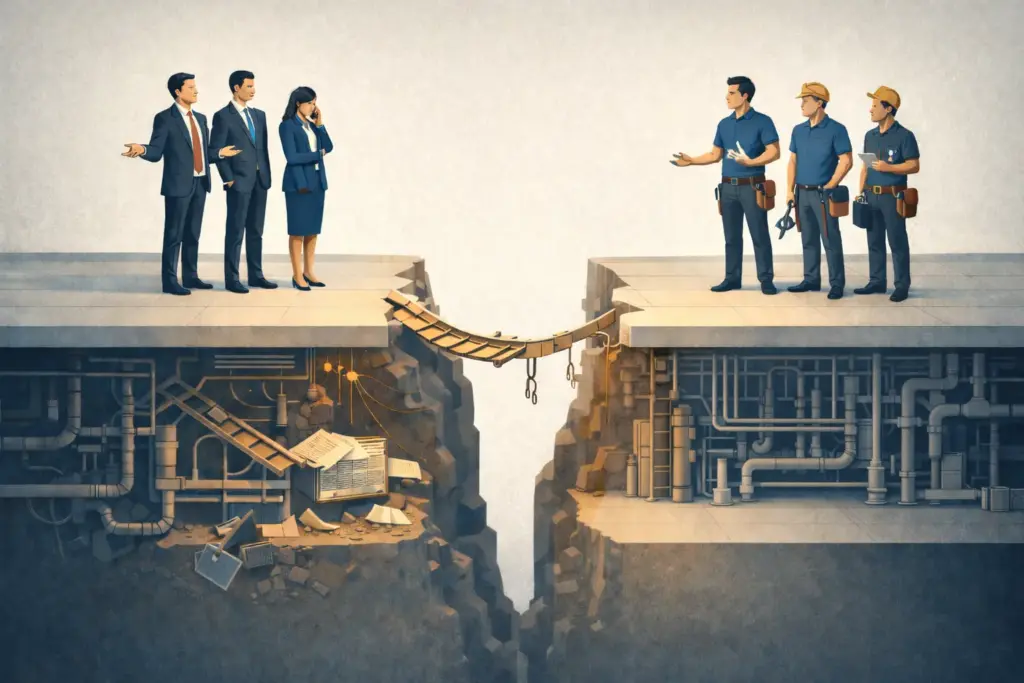
They need a trusted place to start. They need to describe what is happening in their own language and reach someone who can connect that experience to the system underneath it.
Most support environments are organized around the provider. Users experience them from the other side.
That gap creates wasted time, incomplete information, frustration, and work that gets passed between people who each own only one piece. So I began building tools that connected systems with the people experiencing them: client tools, IT tools, and operational knowledge brought together in one place.
A bridge between the person reporting the problem and the person responsible for understanding it.
That became the product I set out to build.
It was not created from a market map or a pitch deck. It grew from patterns I had watched repeat for years, and I built it slowly, from the ground up, with users.
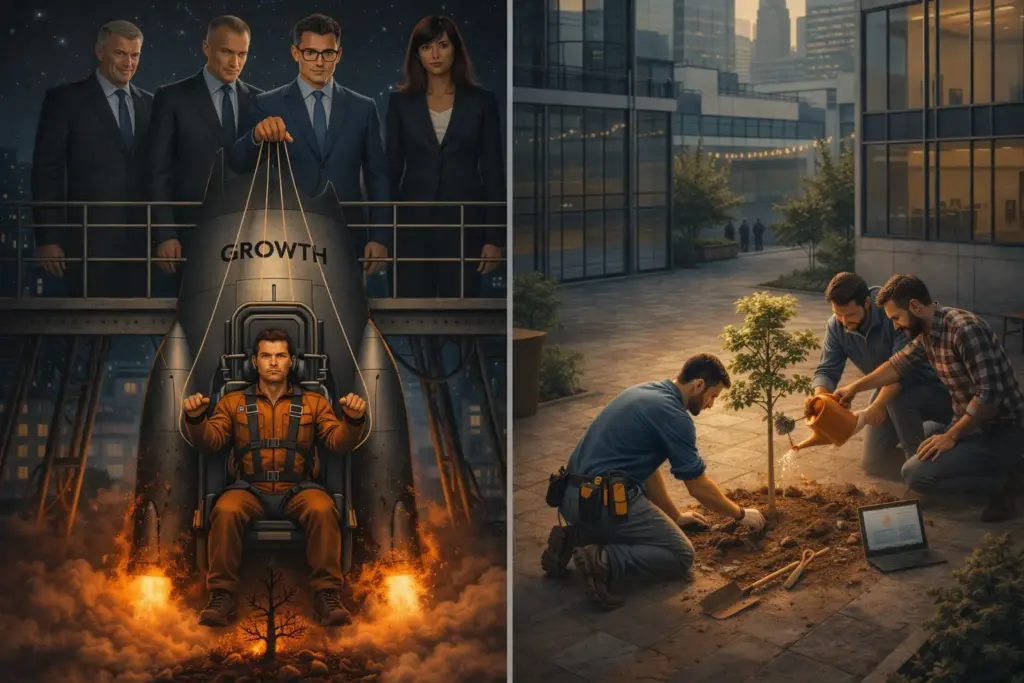
As it developed, the usual conversations appeared: funding, boards, hiring, and growth targets. Capital is not inherently destructive, but it is directional. It arrives with expectations about growth, timing, control, and return.
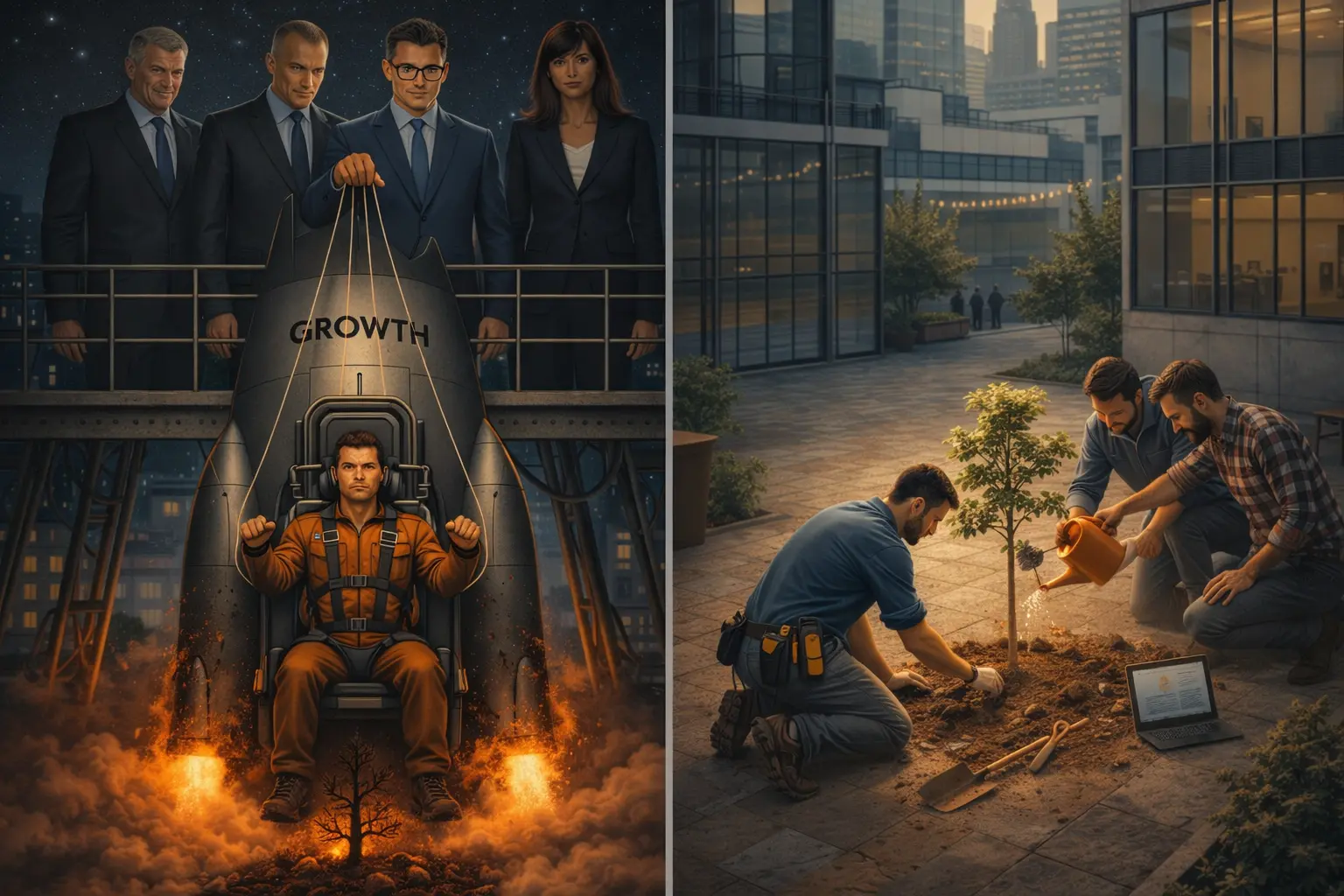
When those expectations match the company being built, capital can accelerate useful work. When they do not, the company gradually begins serving the financial structure around it. The product becomes an asset, customers become units, employees become capacity, and decisions that once reflected care are reframed as questions of scale.
There is another path: build something customers will pay for, keep the organization lean, stay close to the people using the product, and let revenue provide the signal.
That path has constraints too. Growth may be slower, choices have to be more deliberate, and there is less room to hide weak thinking behind spending. But the constraints are visible, and they are chosen.
The goal is not valuation. It is durability.
Success does not mean the same thing to everyone. For some founders, it is a major exit. There is nothing inherently wrong with that, but it creates a particular kind of company and a particular set of incentives.
For me, success looks quieter: a profitable company, a product people depend on, work that remains useful after the novelty fades, and a business that supports a life instead of consuming one.
I want to build a company where the people closest to the problem can still influence the solution, where experience is not treated as resistance, and where growth does not require forgetting why the work mattered in the first place.
That is what I am building.
Customer-funded. Lean by design. Built for durability.
No theater. Just stewardship.
I have spent enough years watching companies lose their soul, not because no one cared, but because the people who cared gradually lost the authority to protect it.
I would rather build one that keeps it.
“Someone’s sitting in the shade today because someone planted a tree a long time ago.” - Warren Buffett