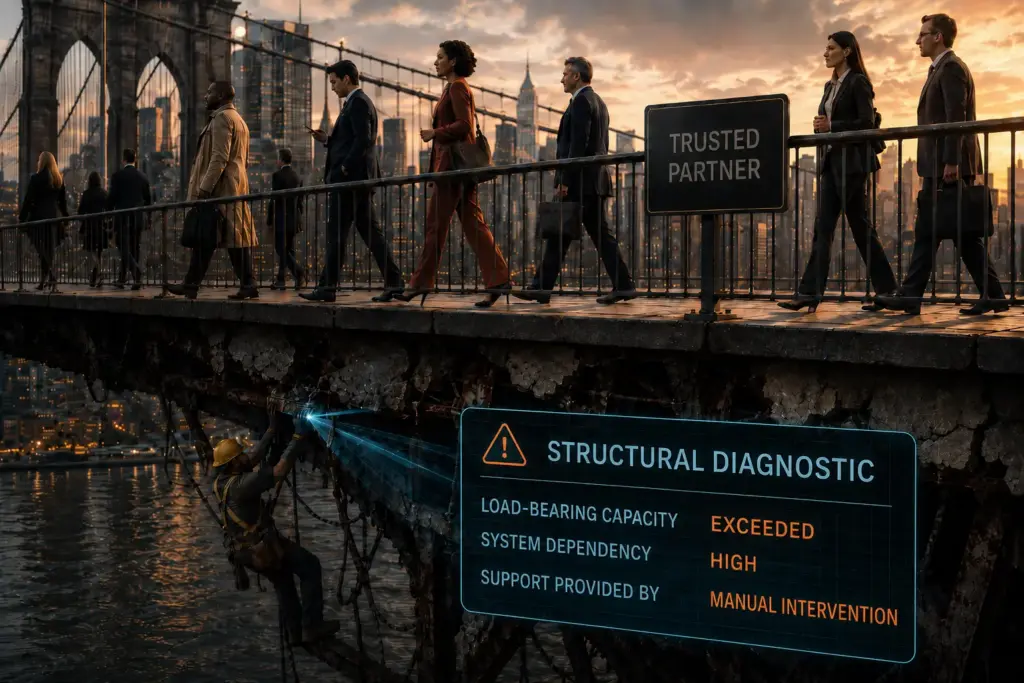
Lessons From Consulting, MSPs, and Operating a SaaS Business
Let’s get this out of the way: there are plenty of bad vendors.
Some layer profit into every handoff, operate as low-value pass-throughs, put clients at risk, and scale by throwing bodies at service. Agencies hire anyone who can fog a mirror. Consultancies sell confidence instead of outcomes.
That deserves its own article. This isn’t it.
I have spent my career working inside companies that serve other companies, including consulting firms, MSPs, MSSPs, enterprise security organizations, and now my own business. I spent more than a decade inside one of the largest technology companies in the world, working with hundreds and eventually thousands of customers.
I have also sat on the other side of the table. I run a SaaS business, and I have hired development agencies, contractors, and third-party service providers. I have been both the vendor and the client.
Getting it wrong inside my own startup nearly sank the ship. I did not always follow the advice I am about to give.
This is not an article about etiquette, a request to be nicer to vendors, or an excuse for poor delivery. It is about organizational self-deception at the boundary between companies.
Hiring outside help makes hidden dependencies visible. An internal team can operate through history, habit, and informal relationships. People know who to ask, which process to ignore, and where the real decisions get made.
A vendor enters without that context. They need access, priorities, documentation, decisions, and someone with the authority to provide them. When those things do not exist, the engagement begins exposing the gaps that internal familiarity had been covering.
Hiring a vendor does not create that dysfunction.
It removes the camouflage.
Bad vendors can fail entirely on their own, but capable vendors also fail inside organizations that are not prepared to manage external execution. The client knows it needs help but cannot define the outcome. Someone is assigned to manage the relationship but given no real authority. Decisions move through several people, none of whom clearly owns the consequence.
Control is performed rather than possessed.
When the engagement begins to stall, the vendor becomes the most visible part of a problem that started inside the client.
This is why hiring experts is an organizational maturity test. An expert does not only bring capability. They require the organization to become legible.
Who owns the decision? What does success mean? Which constraints are real? Who can accept risk? What happens when two leaders disagree?
If an expert walked into your organization today, what would they trip over in the first week?
The Reluctant Owner Problem
One of the most common vendor failures begins with a name on a kickoff slide.
That person is introduced as the owner, even though they did not ask for the vendor, did not select the vendor, and may never have managed a project, team, or third-party relationship before. Now they are expected to become the connection point between two organizations.
Being named the owner and having ownership are not the same thing.
Real ownership requires authority, context, and time. Remove any one of those and the title becomes ceremonial.
The reluctant owner often has accountability without control. They are expected to answer questions but cannot make decisions, move the work forward without being able to prioritize the people the vendor depends on, and manage the relationship while still carrying a full-time role that was never adjusted to make room for it.
From the vendor side, the problem appears gradually. Questions are answered defensively. Requests for clarification are treated like interruptions. A missing decision is reframed as a failure to understand the assignment.
You ask a simple question, and it lands like an accusation. You deliver what was requested and discover that the request was never fully agreed upon internally. Clarification becomes evidence that the vendor was not listening, even when the answer never existed.
Sometimes this is insecurity. A capable outside party may expose gaps in someone’s role, authority, or understanding. More often, the person is simply overloaded and trying not to become responsible for another failure.
The effect is the same.
Disagreement becomes the default because agreement creates exposure. Saying yes means becoming accountable for the result. Saying no requires defending a position. Deferral feels safer than either.
Emails go unanswered, approvals stall, and follow-ups accumulate. Weeks later, an objection appears that could have been surfaced during the first conversation.
From the outside, the vendor cannot tell what happened. Was the message missed? Did the owner lack time? Was there an internal disagreement no one disclosed?
The reason matters less than the result.
Momentum dies.
I call this commitment purgatory: no clear yes, no clear no, just a decision suspended between people while the vendor waits in the middle.
A vendor cannot plan around an answer that may never arrive. Work gets paused, restarted, or completed against assumptions that later become points of dispute.
In these environments, vendors stop functioning as vendors. They become translators between departments, auditors of internal decisions, therapists for frustrated stakeholders, and convenient targets for tensions that existed before the contract.
None of this necessarily means the assigned owner is incapable. It usually means the organization assigned responsibility without creating the conditions required to carry it.
Managing a vendor is a job.
Not a side quest.

“If you avoid conflict to keep the peace, you start a war inside yourself.” - Cheryl Richardson
Bandwidth is Not a Personality Trait
Companies often talk about bandwidth as though it were a personal quality.
Someone is smart, responsive, hardworking, and capable, so the organization assumes they can absorb another responsibility. That is not bandwidth. It is optimism about someone else’s limits.
External help does not remove work immediately. At the beginning, it creates coordination work.
The vendor needs to understand the environment, gain access, meet stakeholders, review existing decisions, identify constraints, and learn how work moves through the organization. Someone inside the client has to make that possible.
When there is no protected time for onboarding, review, and decisions, the vendor begins working against partial context. Every missing document becomes an interview. Every undocumented exception becomes a late surprise. Every unclear authority line becomes an escalation.
This is where organizations confuse effort with capacity.
A person may be highly competent and deeply committed. That does not give them enough hours, decision rights, or organizational leverage to manage an external team.
Bandwidth is structural. It comes from documented systems, clear ownership, protected time, access to the right people, and a reliable way to make decisions.
Without those things, the vendor has nothing stable to attach to.
When processes exist only in someone’s head, the vendor must reverse-engineer them. When authority is informal, every decision becomes political. When priorities change daily, the engagement becomes reactive.
The client may describe this as flexibility. From the outside, it feels like opacity.
If you do not have standards, documented workflows, or clear decision authority, you are not necessarily lean. You may simply be difficult to understand.
Opacity turns every engagement into a guessing game. The vendor has to determine what matters, who decides, which exceptions are acceptable, and how much risk it is allowed to take. Every assumption creates the possibility of delay, rework, or conflict.
The client then experiences the correction as inefficiency, even though the vendor was working from incomplete information.
A good vendor can help organize an unclear environment. It can document, facilitate decisions, and identify where ownership is missing. What it cannot do is manufacture internal consensus, give an employee authority that leadership has withheld, or choose business priorities the client has refused to settle.
External help can absorb execution.
It cannot compensate indefinitely for an organization that will not make itself understandable.
You can outsource execution.
You cannot outsource clarity.
“For every complex problem there is an answer that is clear, simple, and wrong.” - H. L. Mencken
The Hardball Theater Clients
Strong clients negotiate. They challenge estimates, ask difficult questions, enforce scope, and hold vendors accountable for what they promised.
That is not hardball theater.
Hardball theater begins when pressure replaces governance. Every meeting becomes a test of dominance. Pricing is challenged for effect. Timelines are compressed without changing scope. Boundaries are treated as evidence that the vendor lacks commitment.
Trust becomes a weakness to exploit rather than a condition required for useful work.
This behavior is often presented as rigor. Usually, it appears when the client has not defined the outcome clearly enough to manage the engagement another way. When expectations are vague and ownership is fragmented, pressure becomes the only available control.
So it gets used everywhere.
A vendor surfaces a risk and is told to be more solution-oriented. An estimate is treated as an opening bid rather than information. A request for clarification is interpreted as resistance.
The client believes it is keeping the vendor honest. What it is actually doing is teaching the vendor which truths are dangerous to say out loud.
Vendors adapt to the environment around them. When honesty is punished, communication narrows. Estimates become defensive. Risks are softened until they can no longer be ignored. Creativity disappears because every new idea creates another opportunity to be blamed.
The relationship shifts from solving the problem to surviving the engagement.
That produces the opposite of what the client intended. The best vendors do not compete on desperation. They leave.
What remains are vendors willing to price volatility into the contract, discount themselves to stay in the room, or agree to commitments they know should not be made.
The client thinks it has created leverage.
It has selected compliance over judgment.
A vendor that is afraid to disagree is not a partner. It is an order taker waiting for the next instruction. That may feel easier in the moment, but it transfers every difficult decision back to the client.
You hired expertise, then punished the vendor for using it.
Rigor makes risk visible.
Theater drives it underground.
“Power is not revealed by striking hard or often, but by striking true.” - Honoré de Balzac
The “I Could Just Do This Myself” CEO
I once had a CEO join a call and announce:
“I could just start my own IT company.”
They worked in a completely different industry, which raised an obvious question: why are we here?
The statement was not really about capability. It was about distance from the work.
When leaders are far enough removed from a system, complexity collapses into outputs. They see tickets closed, systems running, employees hired, and reports delivered. They do not see the recruiting, retention, domain knowledge, coordination, escalation, and operational risk required to produce those outcomes consistently.
The output makes the work look simpler than the system that produces it.
Of course, the CEO could start an IT company. Anyone can register a business, hire employees, and sell a service. The difficult part is building an organization capable of delivering that service repeatedly, safely, and under pressure.
Confidence is easy when you only encounter the visible result.
The same distance appears in a quieter form with absentee clients. They rarely engage while the work is moving. Emails go unanswered, meetings are skipped, and decisions are deferred. The relationship runs on autopilot because no one inside the client has made it important enough to manage.
Then something fails to land exactly as expected, and attention suddenly appears, often near renewal.
“What exactly are we getting?”
“Why do we even need this vendor?”
The questions may be reasonable. The timing is not.
The client is auditing a relationship it declined to participate in.
For months, the vendor worked without updated priorities, meaningful feedback, or access to the people required to judge whether the work mattered. Silence was treated as consent until it became useful to reinterpret it as failure.
This is not accountability. It is retroactive management.
A vendor can report what it did. It cannot guarantee that the work remained aligned with priorities the client never communicated. It cannot infer leadership changes, internal objections, budget concerns, or strategic shifts that were never shared.
Shared outcomes require shared participation.
You cannot disappear from the responsibility and reappear only as the judge.
In both the dismissive CEO and the absentee client, the underlying problem is the same: authority exists without engagement. The vendor is treated as a replaceable function while being expected to carry context, judgment, and responsibility for the whole environment.
When ownership becomes abstract, vendors become convenient proxies for decisions no one wanted to make.
“We are not thinking machines that feel. We are feeling machines that think.” - Antonio Damasio
What Good Clients Actually Do
Good clients are not easy clients. They do not agree with every recommendation, approve every invoice without question, or surrender judgment to the vendor.
They create the conditions for useful disagreement.
Good clients know what they want before they hire, or at least know how the decision will be made when the answer is not yet clear. They can explain the problem, the consequence of leaving it unresolved, and what a better state would look like. They distinguish between a required outcome and a preferred implementation.
When those things are still uncertain, they say so. Ambiguity is manageable when it is visible.
They assign an owner with real authority, not just accountability in name. That person has access to leadership, enough context to explain the environment, and protected time to manage the work. When the owner cannot make a decision alone, the escalation path is already known.
Good clients make the organization legible. They document how work flows, how priorities are set, who controls access, and who breaks ties when opinions diverge. They identify the systems, people, and business periods the engagement cannot disrupt.
The documentation does not need to be perfect. It needs to be honest.
Good clients do not expect the vendor to reverse-engineer their politics. They explain where authority actually sits, including when that differs from the organizational chart.
They also understand what hiring an expert is for. Outside help is not there to absorb confusion indefinitely. It is there to improve the quality and speed of decisions.
A capable vendor will expose things the client has avoided: unclear ownership, undocumented dependencies, competing priorities, weak controls, and assumptions that do not survive contact with the environment. Good clients do not punish the messenger for making those gaps visible.
They use the engagement as a forcing function, turning ambiguity into decisions and private assumptions into shared structure. They ask vendors to surface risk early, then create conditions in which an unwelcome answer can be given honestly.
Bad news delivered early is useful. Bad news hidden until the deadline is expensive.
Good clients also own their share of delay. They distinguish between a missed vendor commitment and an unresolved client decision. They do not reopen settled questions without new information, then blame the vendor for the resulting rework.
They make urgency specific rather than declaring everything urgent. They understand that speed comes from alignment, not pressure.
A good client does not remove accountability from the vendor. It makes accountability possible.
The vendor remains responsible for its promises, expertise, and quality of execution. The client remains responsible for access, decisions, internal coordination, and the business outcome it chose to pursue.
Neither party can outsource its side of the relationship.
Being a good client is not about being nice. It is about being prepared to decide, participate, hear what the expert was hired to see, and own the outcome.
Expertise does not create readiness.
It reveals it.
“The willingness to accept responsibility is the mark of a leader.” - Tacitus