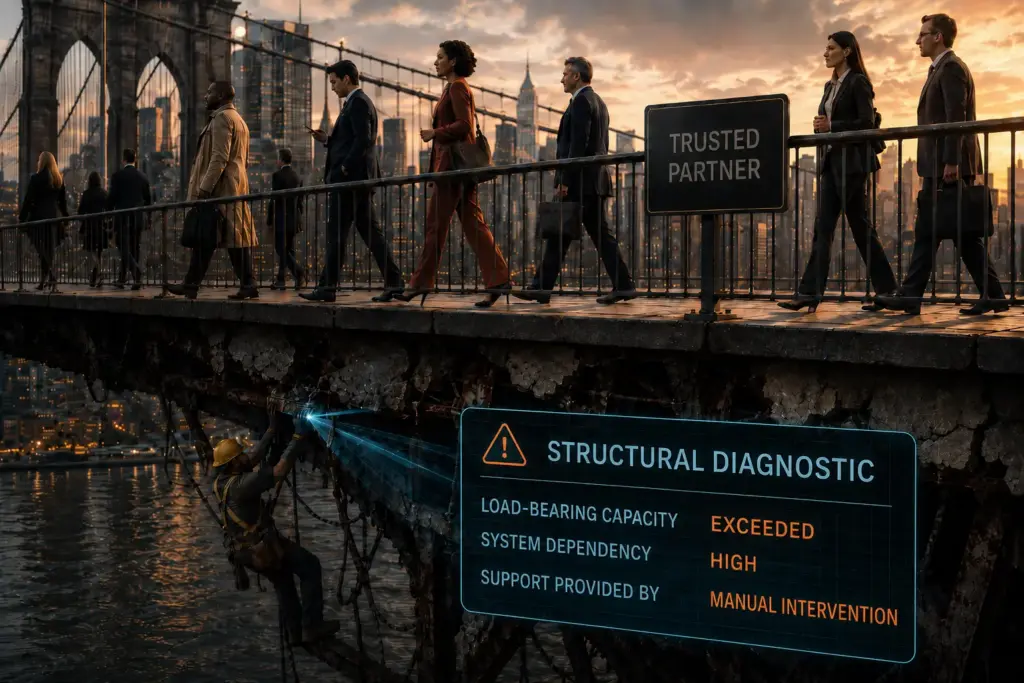
Every IT transition begins with confidence.
The incoming provider has a plan, leadership has a timeline, and finance has a number that looks cleaner than the one before it. Everyone agrees that this time will be different: more organized, more modern, and less messy.
Almost every time, that confidence arrives before understanding.
What gets lost in a handoff is rarely tooling, talent, or effort. Those can be replaced. What gets lost is memory.
That memory explains why systems look the way they do, which exceptions are intentional, who depends on what, and why a change that appears simple can create weeks of cleanup. Some of it lives in documentation, but much of it remains buried in tickets, old incidents, private conversations, and the judgment of people who have watched the system fail.
Transitions do not fail at cutover. Cutover reveals the failures that happened earlier.
The real failure begins when a transition is treated like a purchase instead of a transfer of responsibility and context. Silence is mistaken for leverage. Cooperation is assumed rather than negotiated. The incumbent is treated as an obstacle, while the incoming provider commits before discovery.
The plan looks clean because the difficult parts were never allowed onto the page.
By the time the first outage, missed dependency, or access problem appears, the organization assumes something new has gone wrong. Usually, something old was forgotten.
IT does not lose control during a transition.
It loses memory before the transition is complete.

“In theory, there is no difference between theory and practice. In practice, there is.” - Yogi Berra
Four Views of the Same Change
Every transition creates the same four perspectives. The incumbent holds the history. The incoming provider holds the promise. Leadership and finance hold the decision. The referee appears when those versions of reality no longer match.
The titles change. The incentives do not.
The Incumbent: Memory Without Narrative Power
The incumbent holds the scars. They remember the outage that forced a workaround, the vendor dependency that failed quietly, and the temporary fix that became permanent because it kept the business running. They know which shortcuts are intentional and which ones are landmines.
What they often lose during a transition is narrative power. Once replacement is announced, context begins to sound like defensiveness and warnings are interpreted as resistance. The people trusted to keep the systems running yesterday become friction today.
The incumbent is not automatically right. They may have documented poorly, defended bad decisions, or allowed too much knowledge to remain inside a few people. They may also have reasons to make the transition difficult.
None of that makes their knowledge disposable.
A mature transition listens without surrendering control. It verifies what the incumbent says, separates fact from posture, and asks why the current state exists before trying to replace it.
Institutional memory rarely disappears all at once. First, it loses its seat at the table.
The Incoming MSP: Confidence Without Scars
The incoming provider arrives with a playbook, a preferred stack, and examples of similar transitions that worked. That confidence has value because it calms leadership and creates momentum.
It is also cheapest before reality appears.
Sales rewards optimism. Case studies compress complexity. Documentation is assumed to be current, access is assumed to be available, and cooperation is assumed to be waiting.
Most incoming providers are not lying. They are generalizing from environments that looked similar from the outside.
A playbook is a starting point, not a map of this environment. It does not know the exceptions, relationships, historical compromises, or business sensitivities that shaped the current state.
The danger begins when early confidence becomes a public commitment. New information then feels like a threat to the timeline, savings, or certainty already sold.
Confidence is useful when it creates action. It becomes dangerous when it stops learning.
Leadership and Finance: Legibility Over Truth
Leadership and finance need a cost, a timeline, an accountable party, and a reason the new model will be better. Spreadsheets make the transition legible. Invoices line up, services look comparable, and the change begins to resemble removing one provider and replacing it with another.
Same outcome. Cleaner cost.
But invoices may be comparable while operating knowledge is not. The old provider knows which executive needs advance notice, which service account nobody touches, which application owner left two years ago, and which backup has never been restored under current conditions.
That knowledge does not appear in a pricing table.
The real transition cost includes discovery, incumbent assistance, parallel operations, internal coordination, delayed projects, and relearning facts the organization already paid to discover.
Relearning is the hidden line item. It appears after the decision has been celebrated, when the savings story is fixed and the new risk has moved into operations.
If the plan fits perfectly in a spreadsheet, the real risk is probably outside the cells.
The Referee: Called In When Confidence Runs Out
The referee appears when the narratives separate. The incumbent says the environment cannot be moved as planned. The incoming provider says the required information was never supplied. Leadership realizes it is wedged between two organizations, each confident and neither fully trusted.
The referee may be an independent consultant, an internal program lead, or the one technical person leadership still believes can separate fact from posture. Their job is not to choose a side. It is to restore signal.
They establish what is known, what is assumed, what has been verified, and who owns the next decision. They turn scars into sequence and make missing information visible before it becomes another surprise.
Their late arrival is itself a signal. The transition had no trusted mechanism for resolving uncertainty. It had competing stories and hoped one of them would become true.
“Facts do not cease to exist because they are ignored.” - Aldous Huxley
Confidence Without Sequence
Most transitions do not fail because every decision was wrong. They fail because reasonable decisions were made in the wrong order.
Leadership wants flexibility, finance wants options, and vendors want momentum. No one wants to close a door too early, so commitments remain soft and difficult conversations are delayed. The plan stays adjustable, but the work does not become safer.
Silence Framed as Strategy
Withholding information can feel like leverage. Leadership may worry that the incumbent will disengage, procurement may want to preserve negotiating power, and the incoming provider may be kept at a distance until the agreement is final.
Some information does need to be controlled, but the transition still depends on people whose knowledge and cooperation must eventually be secured. When they are told too late, they may become defensive, uncertain, or unavailable. When the incoming provider plans against incomplete facts, assumptions begin hardening into commitments.
Silence is not neutral. It reduces the time available to capture knowledge and turns information into something people protect rather than share. By the time the silence breaks, trust has already been spent.
Optionality as Avoidance
Optionality is useful when a decision is genuinely reversible. It becomes avoidance when the organization refuses to decide while expecting everyone else to prepare.
“We are still evaluating.” “We have not finalized direction.” “We are keeping our options open.”
Meanwhile, the incumbent does not know what to transfer, the incoming provider plans around imaginary cooperation, and internal teams delay work because they do not know which platform will survive.
A transition does not require every decision to be final on day one. It does require clarity about which decisions remain open, who owns them, and when the uncertainty must end.
Optionality without a decision path is not leverage. It is suspended accountability.
Cooperation Assumed, Not Negotiated
Organizations often build transition plans around help they never secured. They assume the incumbent will answer questions, export data, explain exceptions, train the incoming team, and remain available after termination because helping is the professional thing to do.
Sometimes that happens. It should not be the plan.
A serious transition defines who will participate, what artifacts must be delivered, which access must be transferred, what meetings are required, how long assistance will remain available, and when additional work will be paid.
If the incumbent is likely to be hostile or unavailable, the plan should acknowledge that and reduce its dependence accordingly. Goodwill can improve a transition, but it cannot be a critical dependency.
Sequencing Ignored Because It’s Boring
Sequencing does not make an announcement look ambitious. It often slows the visible start because teams must first discover what has to happen before the satisfying work can begin.
So it gets skipped.
Tools are selected before dependencies are mapped. Access is revoked before credentials are transferred. Monitoring is removed before its replacement is validated. Licenses are canceled before retention is confirmed, and cutovers are scheduled before rollback conditions exist.
The checklist still shows progress, but the service is not ready.
A completed task is not the same as a safe next state. Sequencing is where a transition actually lives because some actions are reversible while others remove the only path back.
The lights stay on right up until they do not.
“The greatest danger in times of turbulence is not the turbulence; it is to act with yesterday’s logic.” - Peter Drucker
Structure Beats Heroics
The transitions that work are not necessarily cleaner. They are stricter about what cannot be left to chance.
Cooperation is defined, knowledge has somewhere durable to live, dependencies are visible, and decisions have owners. Each stage produces enough evidence to show that the next one is safe. Unexpected problems still appear, but the plan does not depend on exceptional effort to survive them.
Cooperation Is a Design Choice
The best time to define transition assistance is at the beginning of a relationship, not at the end. Contracts should address data ownership, documentation, access, exports, transition services, and what happens when the relationship ends.
That does not make the relationship adversarial. It makes the exit understandable before anyone is angry.
During the transition, cooperation should be specific, scoped, and time-bound. Everyone should know who is helping, what they own, what has been completed, and where the obligation ends. Goodwill is useful, but clarity is what preserves it.
Knowledge Needs a Container
Most organizations do not lack institutional memory. They lack somewhere durable to put it.
Some knowledge lives in people’s heads, some is buried in tickets, and some sits in documents describing a system that no longer exists. A document dump does not solve that problem because the value is not only in recording what exists.
The transition also needs to preserve why something exists, who depends on it, which exceptions are intentional, what has been validated, and what remains unknown. Decisions need rationale, workarounds need history, and risks need owners.
The container does not need to be perfect. It needs to support continuity.
Sequencing Is a First-Class Concern
A transition plan cannot be only a collection of tasks and dates. It has to represent dependency.
Each meaningful step needs prerequisites, an owner, evidence of completion, acceptance criteria, and a recovery path. The team should understand what becomes possible after the step and what becomes impossible if it goes wrong.
Checklists show whether work was performed. Sequence shows whether the system is ready to move.
Strong transitions assign someone to own that order across teams, not only the individual tasks inside it.
Accountability Must Be Explicit
Shared responsibility sounds collaborative, but during a transition it often means no one has enough authority to make the decision that unblocks the work.
There should be one accountable transition owner who can resolve conflict, accept risk, and stop the plan when the evidence does not support proceeding. The client, incumbent, and incoming provider should each understand what they own, what they depend on, and what happens when an obligation is missed.
If accountability is not named and written down, it will be reconstructed during the incident by whoever has the best email history.
That is not governance. It is hope with better formatting.
Why Heroics Are a Smell
Heroics can feel reassuring because they show that capable people are willing to step in when something goes wrong. During a genuine exception, that effort may be necessary.
The problem begins when the transition depends on it.
If success requires repeated late nights, one person remembering every dependency, or senior people constantly repairing failed handoffs, the structure is wrong. Exceptional effort may save the transition, but it should not be confused with evidence that the plan was sound.
“A system is perfectly designed to get the results it gets.” - W. Edwards Deming
Where the Missing Information Goes
The information that matters most often has nowhere durable to live, so it gets lost, relearned, and eventually rediscovered through failure.
The Information That Never Makes It Into the Plan
Every environment contains knowledge that is difficult to classify. An application can be restarted, but only after another service. An executive needs advance notice before an authentication change. An office still depends on a device everyone believes was retired. A security exception remains because the alternative once stopped production.
This is not trivia. It determines whether the plan survives contact with the business.
Traditional documentation records configurations, assets, credentials, and procedures. Tickets capture discrete work. Neither naturally preserves the full relationship between technical state, organizational history, human preference, and business consequence.
For years, that missing layer lived in the heads of senior engineers. It disappeared when they left or became a bottleneck because only one person truly knew the client.
That is not only a staffing problem. It is an information architecture problem.
The Approach: Client Intel
Client Intel exists because institutional memory has been treated like folklore instead of infrastructure.
Every MSP eventually develops the same pattern: one engineer knows the client. They know more than the technology. They understand the people, the history, the sensitivities, the recurring failures, and which shortcuts are safe enough to leave alone.
Traditional tools document what exists and how it is configured. Client Intel is intended to preserve the missing layer: why the environment looks this way, who depends on it, what happened before, and what someone new needs to understand before acting.
It does not replace documentation, ticketing, or monitoring. It connects those systems to the client they are supposed to serve.
The goal is to make context structured enough for a team and its tools to use without stripping away the nuance that made it valuable. The organization should know the client the way its best engineer does without requiring that engineer to be present for every decision.
Project Path: Turning Chaos Into Sequence
Capturing the knowledge solves only half the problem. Someone still has to turn it into order.
Project Path treats a migration as a move from one operating state to another, not as a simple vendor or tool swap. The source environment has dependencies, exceptions, and history. The target introduces new constraints and failure modes. Between them is a sequence of decisions in which some steps cannot safely begin until others are complete.
A checklist records activity. A path shows readiness.
Project Path is intended to force discovery before commitment, connect tasks to dependencies, surface unresolved tradeoffs, and make each step depend on evidence from the one before it. It does not remove nuance. It makes nuance visible while there is still time to act on it.
Actual Intelligence
Client Intel and Project Path depend on the same idea: real expertise is accumulated.
It includes the vendor behavior no datasheet mentions, the bug that appears under one specific condition, the migration order learned from a failed cutover, and the client sensitivity discovered after a technically correct decision damaged trust.
That is Actual Intelligence. It is not instinct treated as authority. It is knowledge captured with context, connected to evidence, updated when reality changes, and available when a decision depends on it.
AI can search, summarize, and help people act faster. It cannot recover context the organization never captured. If the source material contains no scars, the output will still be confidence without scars.
The choice is not between human expertise and artificial intelligence. The work is preserving the expertise humans already paid to earn so both people and systems can use it.
Why I built it
These are products I am building, so pretending this argument is unrelated to them would be its own kind of theater. But the problem came first.
I watched transitions fail for the same reasons across different companies and providers. One person held the client history. Cooperation was assumed rather than secured. Sequence lived in someone’s head. Leadership discovered the missing context only after the timeline moved or the system broke.
The industry often treats this as unavoidable transition pain. Some of it is. More of it is designable than we admit.
Tools cannot create trust, judgment, or leadership. They can give memory a durable home, make assumptions visible, connect context to sequence, and stop each new team from beginning at zero.
That is the work.
Curtain
The hardest part of an IT transition is not changing the technology. It is changing the technology without discarding what the organization already knows.
A new provider may be better. The target stack may be cleaner. The cost model may be stronger. None of that justifies paying to relearn the same environment through outages, delays, and damaged trust.
Preserve the memory, negotiate the cooperation, own the sequence, and make accountability visible before the first difficult decision arrives.
A handoff should move responsibility without resetting understanding.
Change the provider. Change the stack. Keep the memory.
#actualintelligence
“What is essential is invisible to the eye.” - Antoine de Saint-Exupéry